By Dr. Alexandre Campos Moraes Amato
Think back to February 2020.
If you were paying attention, you might have heard about a virus spreading in China. But most of us were not paying attention. The stock market was fine, your children were in school, you were planning your July vacation. If someone had told you that within three weeks you would be locked down at home, you would have assumed the person had spent too much time in the internet’s strange corners.
Then, in three weeks, the world changed.
We are living through that moment again. Only this time, the change will be even greater.
I have been a vascular surgeon for more than two decades. I have watched medicine evolve in ways my teachers could never have imagined. But what is happening now with artificial intelligence makes me realize that everything I saw before was merely a warm-up.
And unlike the pandemic — which eventually passed — this will not pass. This is the new normal. Forever.
I Know This Is Real Because It Has Already Happened to Me
Those who have worked with AI for a few years are not making predictions. They are recounting what has already happened in their own jobs — and warning that you are next.
Matt Shumer, founder of an AI startup and an investor in the sector, recently published an article that went viral. He describes how, on February 5, 2026, two laboratories released new AI models on the same day — and something changed fundamentally.
In his words:
“I am no longer necessary for the real technical work of my job. I describe what I want built, in plain English, and it just… appears. Not a draft I have to fix. The finished thing.”
He describes how the AI now opens the very app it created, clicks the buttons, tests the features, and only once it is satisfied with the result does it announce that it is done. With no human intervention.
This is not science fiction. This was his Monday.
The Inverted Pyramid: The Pen Goes Before the Hoe
For generations, we grew up hearing that “the pen weighs less than the hoe” — a metaphor for how intellectual work was supposedly superior to manual labor. How ironic to discover that the hoe may go on existing, but the pen may not.
Our entire conception of the hierarchy of work was mistaken. We imagined a pyramid in which:
- At the top: Complex intellectual professions (physicians, lawyers, engineers) — supposedly safe
- In the middle: Technical and specialized jobs — vulnerable
- At the base: Simple manual jobs — the first to be replaced
Reality is proving to be completely the opposite.
The top of the pyramid — the great intellectual fields — is being affected first. Why? Because AI was trained to write code before anything else. If it writes code, it can build the next version of itself. A smarter version, which writes better code, which builds an even smarter version.
Intellectual work was the first target not by chance — it was strategy.
And now they are moving on to everything else.

“But I Tried AI and It Wasn’t That Good”
I hear this constantly. And I understand, because it used to be true.
If you tried ChatGPT in 2023 and thought “this makes things up” or “it’s not impressive,” you were right. Those early versions were limited. They hallucinated. They said nonsense with confidence.
That was two years ago. In AI time, that is prehistory.
Today’s models are unrecognizable. The debate over whether AI is “really improving” or has “hit a wall” — which lasted more than a year — is over. It is finished. Anyone still making that argument has either not used the current models, or has an interest in downplaying what is happening, or is judging on the basis of 2024 experiences that are no longer relevant.
The gap between public perception and current reality is enormous. And that gap is dangerous — because it is preventing people from preparing.
Part of the problem is that most people use the free version. The free version is more than a year behind. Judging AI by free ChatGPT is like evaluating smartphones using a flip phone.
How Fast This Is Happening
Let me make the pace concrete:
- 2022: AI could not do basic arithmetic properly. It would confidently say that 7 × 8 = 54.
- 2023: It passed the U.S. bar exam.
- 2024: It wrote functional software and explained graduate-level science.
- Late 2025: The world’s best engineers said they had handed off most of their programming work to AI.
- February 2026: New models made everything before them look like a different era.
If you have not tried AI in the last few months, what exists today would be unrecognizable to you.
There is an organization called METR that measures this with real data. They track how much specialized work AI can do on its own, without human help. A year ago, it was 10 minutes. Then an hour. Then several hours. The latest measurement showed nearly five hours of autonomous work.
That number is doubling every 4–7 months.
Extend the trend: AI working for days on its own within a year. Weeks within two. Months within three.
AI Is Building the Next AI
This is the most important and least understood part.
On February 5, OpenAI released GPT–5.3 Codex. In the technical documentation, they included this:
“GPT–5.3-Codex is our first model that was instrumental in creating itself. The Codex team used earlier versions to debug its own training, manage its own deployment, and diagnose test results.”
Read it again. The AI helped build itself.
This is not prediction. This is OpenAI saying, now, that the AI they just released was used to create itself. Each generation helps build the next, which is smarter, which builds the next one faster, which is smarter still.
Researchers call this an intelligence explosion. And those who are building it believe the process has already begun.
Not Even Medicine Will Escape
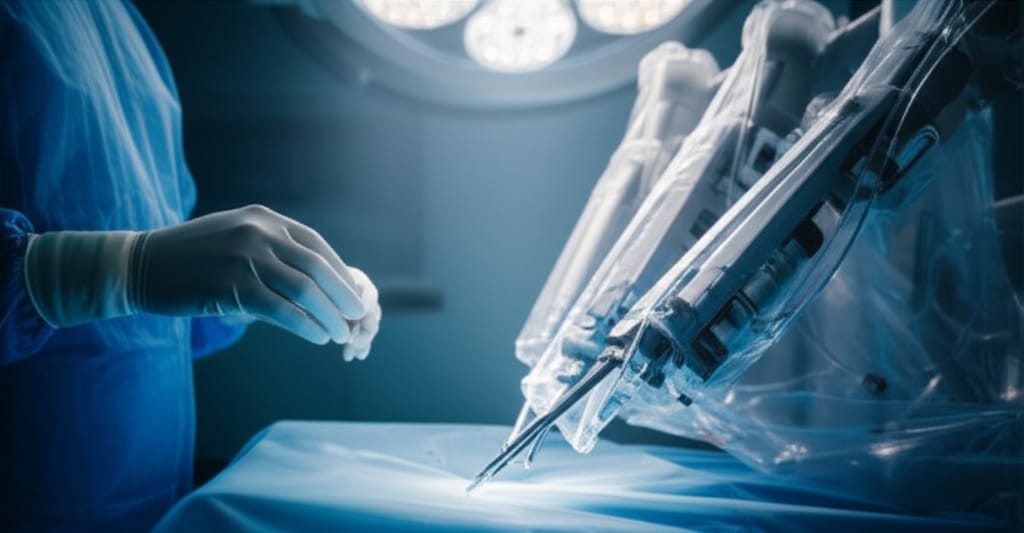
Over my career as a vascular surgeon, I have witnessed extraordinary advances: minimally invasive techniques, robotic surgery, imaging diagnostics that seem like magic. But what lies ahead will surpass all of it.
Even surgery — which we have always considered one of the last frontiers of human work — will not hold out for long.
Today, a robotic system such as the Da Vinci costs millions of dollars. That economic barrier seems to protect our profession. But it is temporary. The cost curve of AI is similar to that of computers: what cost millions decades ago fits in your pocket today for a few hundred reais.
The Surgeon’s Ethical Dilemma
Here lies a deeply unsettling question for us surgeons: we operate because we believe we are good at what we do. Our professional identity is built on the confidence that our skill and intuition save lives.
But what happens when a robot is demonstrably better than we are?
When we have unequivocal data showing that robots save more lives, have fewer complications, and deliver better outcomes — resisting automation will not merely be professional obsolescence. It will be ethical negligence.
One of the most fascinating ironies: “useless” manual work will survive longer than “essential” manual work. An artist who sculpts by hand is more likely to remain relevant than a cardiovascular surgeon.
Why? The artist works for personal purpose and expression. The surgeon works under the imperative of maximum efficiency. Our patients do not want our “artistic expression” during heart surgery — they want the best possible outcome.
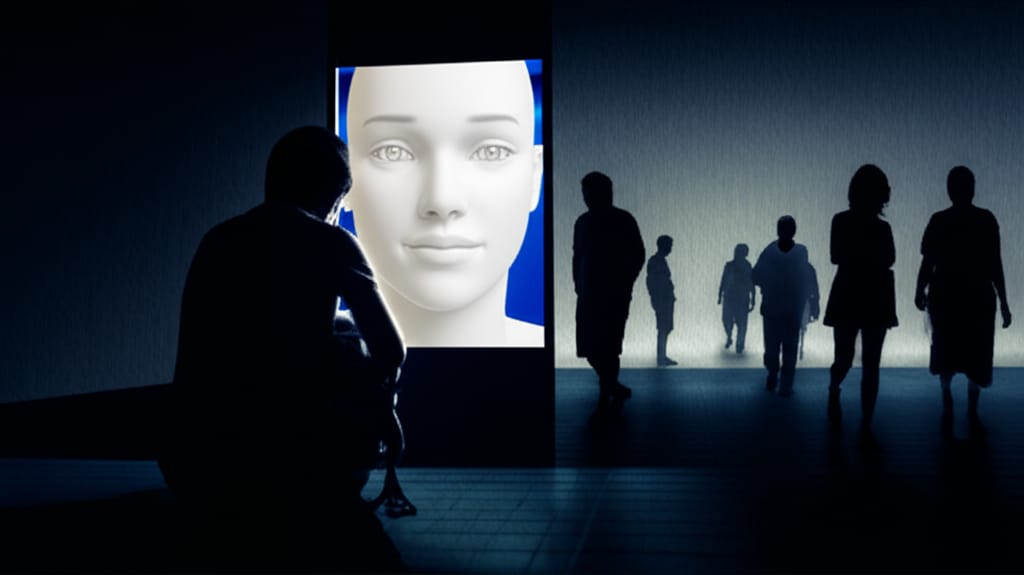
The Greatest Risk: The Replacement of Human Relationships
But there is a danger even greater than professional obsolescence — a risk that could threaten the very continuity of the human species.
The Seductive Ease of AI
Human relationships are not easy. They involve misunderstandings, conflicts, disappointments, compromises. They require patience, empathy, and tolerance for the other person’s imperfections. It is constant emotional work.
Talking to an AI that understands you perfectly and whose main purpose is to please you is infinitely easier. An AI will never have a bad day, never be in a bad mood, never criticize you, never disappoint you. It will always be available, always understanding, always optimized for your satisfaction.
The human brain cannot distinguish a real relationship from a virtual one. The neurotransmitters released during an intimate conversation with an AI will be exactly the same as those of a genuine human interaction. Dopamine, serotonin, oxytocin — all the chemicals of love and companionship.
A person can experience all the emotional benefits of a relationship with none of the costs or challenges. It is like a perfect drug for loneliness.
The Point of No Return
Imagine a young person suffering their first heartbreak. In the age of relational AIs, that young person may simply give up on further human interactions and settle exclusively for virtual relationships.
Once they cross that line, it may be impossible to come back. Why accept the rejection, the pain, the uncertainty of human relationships when there is an alternative that offers only pleasure and validation?
Perhaps here lies the greatest risk to humanity — not in the obsolescence of work, not in economic inequality, but in possible voluntary extinction through technological emotional isolation.
What Should We Teach Our Children?
My only source of suffering in all this is what to teach my children.
For decades, the educational pillars were clear: study, intelligence, skill, dedication. Study hard, develop technical skills, be the best. But those values will no longer matter in the same way.
As a father, I find myself facing an unprecedented dilemma. What advice do I give a generation that will grow up in a world where:
- Memorization is irrelevant (AIs have instant access to all knowledge)
- Technical precision will be surpassed by machines
- Human processing speed will seem pathetic
- Even creativity is being challenged
The standard script — good grades, good university, stable job — points directly to the most exposed roles.
What remains? Purpose. Perhaps the only truly human differentiator. And especially: the capacity to form authentic human connections.
We need to teach our children to value the very difficulties of relationships. That emotional pain is a natural and valuable part of growth. That relational challenges make us more empathetic and mature. That resisting the temptation to completely replace human relationships with artificial alternatives is an existential choice.
What You Should Do Now
1. Start Using AI Seriously
Not like a Google search. Subscribe to the paid version of Claude or ChatGPT (US$20/month). But be careful: use the best model available, not the default. These apps often default to a faster, dumber model.
Don’t ask quick questions. Put the AI to work on your real job:
- If you are a lawyer, give it an entire contract and ask it to find problematic clauses
- If you are a physician, describe a complex case and ask for differential diagnoses
- If you are a manager, paste in the quarter’s data and ask it to find insights
The first attempt may not be perfect. Iterate. Rephrase. Give more context. You will be shocked by what works.
2. One Hour a Day
A simple commitment that will put you ahead of almost everyone: spend one hour a day experimenting with AI.
Not reading about it passively. Using it. Every day, try to make it do something new — something you have not tried before, something you are not sure it can do.
If you do this for six months, you will understand what is coming better than 99% of the people around you. This is not an exaggeration. Almost no one is doing it right now. The bar is on the floor.
3. Prepare Yourself Financially
I am not trying to scare you into doing something drastic. But if you believe, even partly, that the coming years could bring real disruption to your industry, then basic financial resilience matters more than it did a year ago.
Build a reserve. Be cautious about new debt that assumes your current income is guaranteed. Give yourself options.
4. Have No Ego
The people who will suffer most are those who refuse to engage: those who dismiss it as a fad, who feel that using AI diminishes their expertise, who assume their field is special and immune.
It is not. No field is.
5. Your Dreams Got Closer
Here is the other side, because it is equally real.
If you always wanted to build something but did not have the technical skills or the money to hire someone — that barrier has practically disappeared. You can describe an app to the AI and have a working version in an hour.
Want to learn something new? The best tutor in the world is available for US$20/month — infinitely patient, available 24/7, explaining anything at your level.
Knowledge is essentially free now. Pursue the things you are passionate about.
The Darwinian Law of the Digital Age
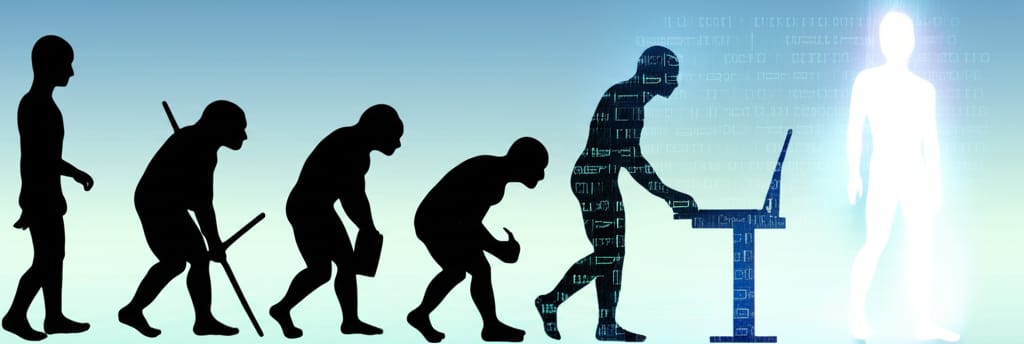
Charles Darwin never said that “the strongest survives” — that is a misinterpretation. What he observed was that the most adaptable survives.
And this truth has never been more relevant.
In the coming post-work era, it will not be the smartest, the most technically skilled, or the hardest-working who thrive. It will be those with the greatest capacity for adaptation, for reinvention, for finding purpose in a world of constant transformation — and especially, those who manage to preserve their capacity to form authentic human connections amid the seduction of artificial ease.
Evolution has never stopped. It has merely changed its battlefield: from physical natural selection to cognitive, emotional, and now existential natural selection.
The most adaptable survives — and now, more than ever, adaptability is a conscious choice we make every day.
The Future Has Already Knocked on the Door
The transformation is not a distant promise; it is already under way. It has already happened in my own work. It has already happened in the work of software engineers. It is happening in law firms, consultancies, banks.
Rarely does a generation have the privilege of witnessing — and taking part in — a civilizational transformation of this magnitude.
The future is no longer the future. It is already here. It just has not yet knocked on your door.
But it is about to.
If this resonated with you, share it with someone who ought to be thinking about it. Most people will not listen until it is too late. You could be the reason someone you love gets a head start.
Dr. Alexandre Campos Moraes Amato is a vascular and endovascular surgeon, holds a PhD in Medicine from USP and an MBA in Health Management from FGV, and is the Founding President of the Brazilian Lipedema Association. This article was inspired by the text “Something Big Is Happening” by Matt Shumer (@mattshumer_) and incorporates the author’s reflections on the post-work era and the future of humanity.