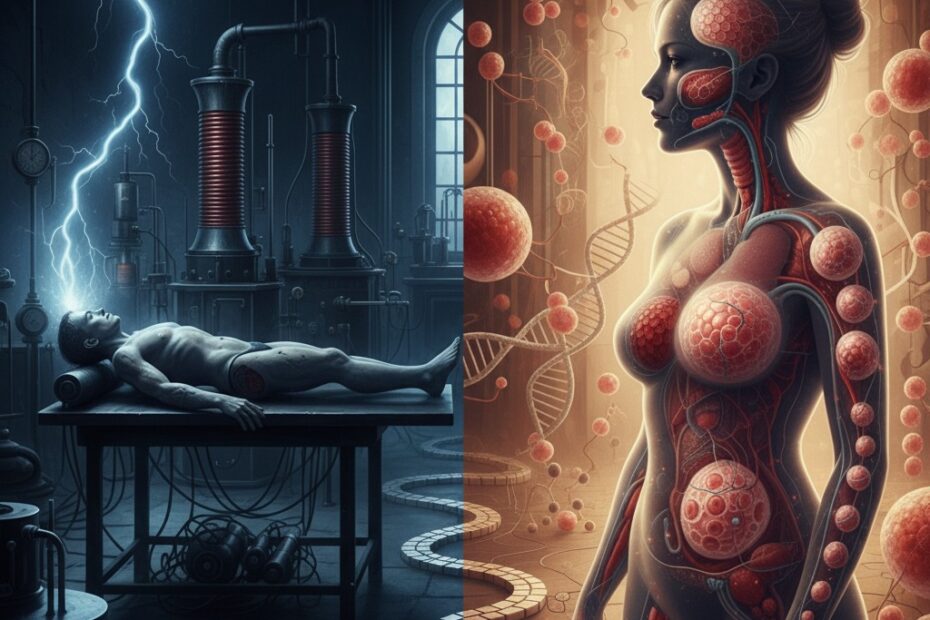
When Mary Shelley conceived Frankenstein in 1818, electricity was the supreme symbol of scientific power. It seemed plausible to believe that a bolt of lightning could breathe life into an inert body. Yet what the work ultimately reveals is the error of reducing life to a mere pulse of energy, ignoring the many layers of processes that sustain it. Frankenstein’s monster is born not of electricity itself, but of the arrogance of trying to master what is not yet understood.
The reflection this classic inspires echoes into the present, in the face of lipedema. We still seek the redeeming “spark”: a perfect surgical technique, a miracle pill, an immediate solution that would erase the disease as though it were nothing more than a build-up of fat. But experience shows us that this view is as reductionist as Frankenstein’s. The true complexity of lipedema is not resolved with sharper scalpels or more potent molecules alone.
Here a contemporary lesson comes into play, one drawn from the book Why Greatness Cannot Be Planned: greatness cannot be charted on a map of rigid goals. Many of science’s greatest discoveries did not arise because someone defined the final objective in advance, but because curious explorers followed unexpected paths. It is like trying to cross a forest: if you look only at the endpoint on the map, you may overlook the shortcuts, the hidden trails, and even the clearings that lead to better horizons.
In medicine, we have countless examples that illustrate this principle. The development of beta-blockers, for instance, did not spring from a direct search for a drug to save millions of patients with heart failure. On the contrary: these drugs were initially believed to be harmful in that setting. It was only through the curiosity of a few clinicians, who dared to explore a seemingly contradictory hypothesis, that their revolutionary benefit was discovered. This trajectory shows that medicine advances not merely through the linear fulfilment of objectives, but through the recognition that exploring alternative avenues can open unexpected doors.
The same applies to lipedema. The cure will perhaps not come from insisting on narrow objectives, endlessly perfecting surgery or tirelessly pursuing the “perfect” drug. Real progress may emerge from research that, at first glance, seems tangential: understanding the role of inflammation, unravelling genetic interactions, exploring connections with the microbiota or metabolism. Every discovery, even one that is not the “final goal,” may open unexpected doors toward effective treatments.
Just as life is not born of a lightning bolt, the cure for lipedema will not come from an isolated spark nor from an inflexible plan. It will come from the sum of integrated knowledge, from the curiosity to explore still-obscure territories, and from the courage to accept that the route to great achievements is often indirect. It is this crossing, and not the illusion of an immediate solution, that brings us closer to a future in which we can offer not merely relief, but true hope.
Alexandre Campos Moraes Amato
Vascular Surgeon