By Dr. Alexandre Campos Moraes Amato
On my last vacation, I stayed home and launched a web application. On my own, it would have taken me a year. It took me a week, orchestrating artificial intelligences that wrote the code, tested it, fixed it, and shipped it. I enjoyed every moment. And yet I am fully aware of something uncomfortable: my application was born dead.
This is not pessimism, it is observation. Any tool we build today on top of artificial intelligence is an intermediary between the user and the AI itself. And recent history shows what happens to intermediaries.
The disappearance of intermediaries
A little over two years ago, I asked an AI to help me create a QR code for a class. It pointed me to a website where I could generate one. Months later, I made the same request, and it simply handed me the finished QR code: the intermediary website had become unnecessary. Today I no longer ask for the QR code. I ask for the whole class, and it comes ready, with the QR code in the right place.
This small domestic example sums up a pattern that repeats on an industrial scale. Every layer of service that sits between a person’s intention and the result they want is being absorbed. Whoever builds a product that merely packages an AI’s capability is building something the next version of that same AI will do natively. The speed of this is unprecedented, because the AI itself takes part in creating the next AI. Models help train, evaluate, and program their successors, and the interval between generations, which used to be years, is now measured in weeks.
I keep building anyway. First because I learn, second because I have fun, third because I believe it helps someone while it lasts. But this realization pushed me back to a question I left open a year ago, when I wrote in this space about the post-work era: if the machine is going to do it better, why keep doing it?
The era of purpose
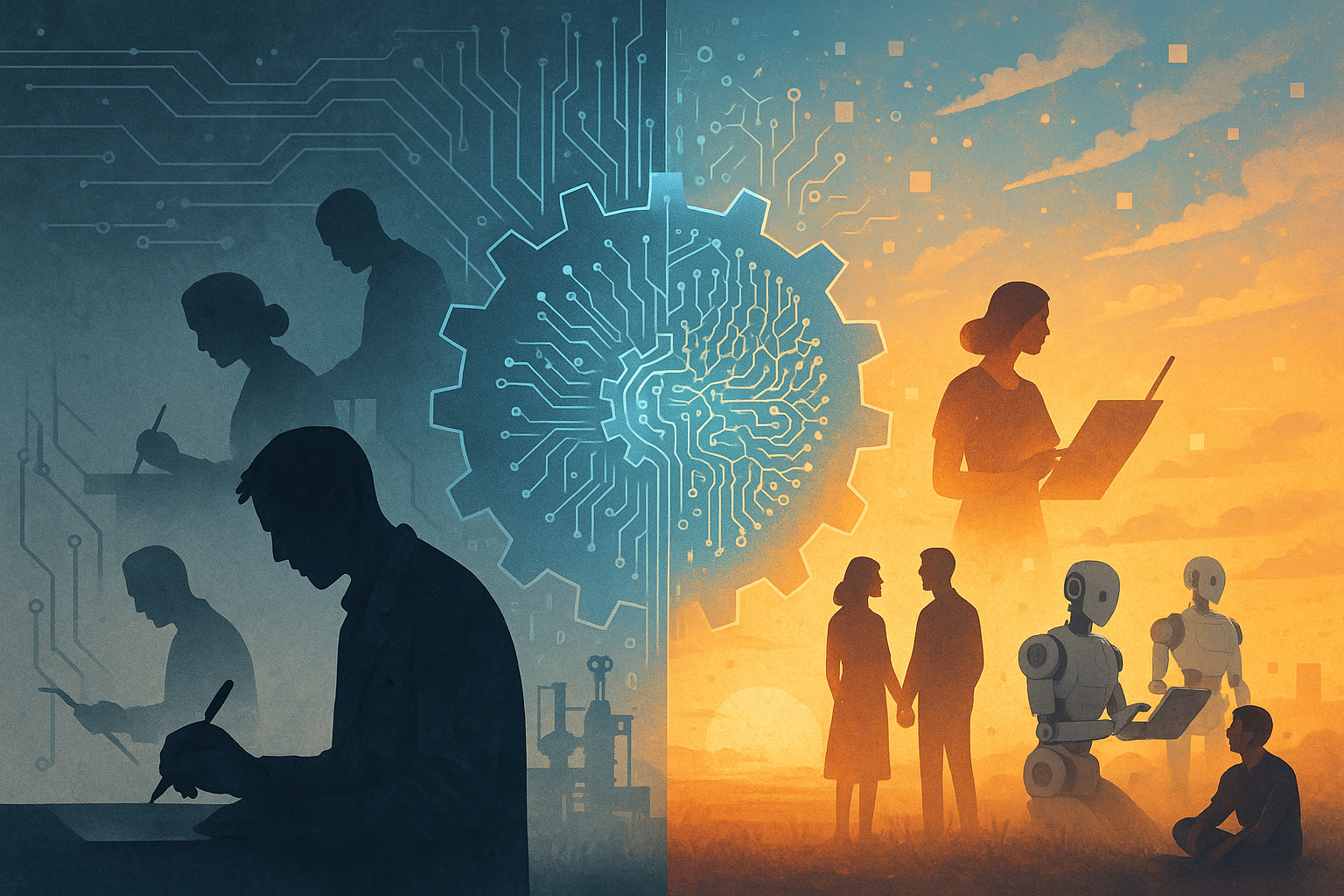
In that article, I used the old metaphor that the pen weighs less than the hoe, and the irony of discovering that the hoe may go on existing while the pen disappears. Intellectual work, which always considered itself superior and irreplaceable, is falling first. A year later, the forecast has only accelerated, and what was a distant horizon has begun to turn into a timetable. I confess a certain ironic relief at having a profession that also uses its hands.
We spent the last few centuries organizing life around work as survival. One works because one must eat, pay bills, support a family. Some are lucky enough to work also out of enjoyment, but enjoyment was always a bonus, never the criterion.
I believe we are entering the era of purpose. When artificial intelligence performs cognitive tasks better and more cheaply than we do, the question “what do you live on?” begins to be replaced by “what do you wake up for?”. If AI does it better than me, the only legitimate reason for me to keep doing it is to enjoy doing it. Those who wake up happy to work have one less problem in this transition. Those who work reluctantly, out of obligation alone, will need to search for a purpose, and that search may be the great psychological challenge of the coming decade.
But there is one domain in which this reasoning takes on a weight that exists nowhere else: health.
The ethical tipping point
I can keep programming for pleasure even when AI programs better than me, because a worse application kills no one. I can play table tennis without being the best in the world, play an instrument badly, paint mediocre pictures. In almost everything in life, being worse than the machine is irrelevant, because the activity is worth it in itself.
In medicine, no. In surgery, even less.
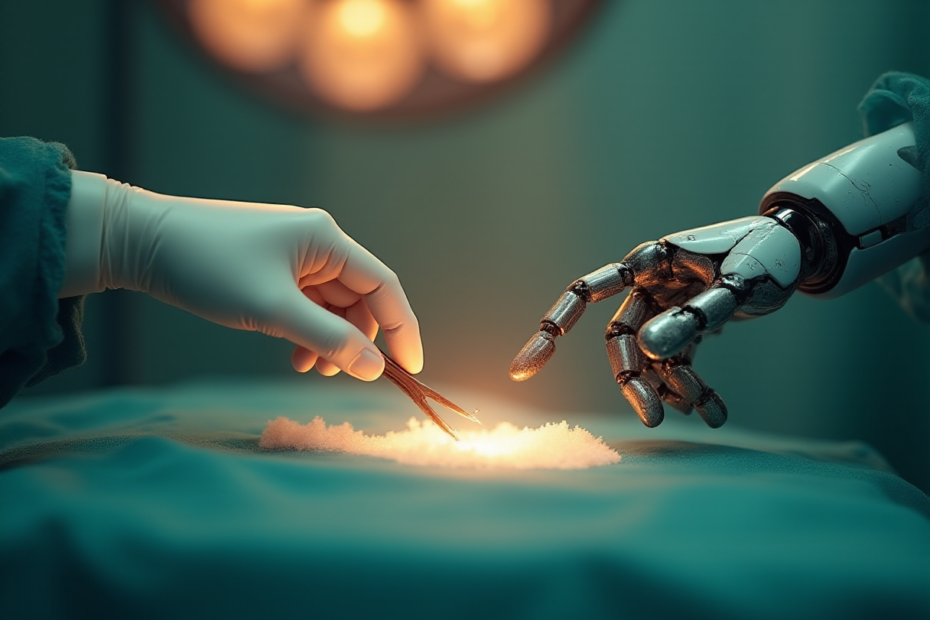
When I wrote about the post-work era, I stated that, on the day robots are proven to surpass human surgeons, resisting automation will not be mere “professional obsolescence,” it will be “ethical negligence.” I return to the point now because it has ceased to be a futuristic footnote and become the central question of my profession. On the day it is demonstrated, with sound methodology, that an autonomous system operates with results consistently superior to mine, with fewer complications, less mortality, and better recovery, continuing to operate out of attachment to the profession will cease to be a romantic choice and become an ethical failure. Love of the craft is not justification for delivering to the patient a worse result than the one available. That is the tipping point: the moment when the physician’s personal purpose collides with the patient’s interest, and the patient’s interest wins, as it has always won in good medicine.
I am not talking about a distant, speculative future. In a randomized clinical trial published in JAMA Network Open, a language model on its own outperformed physicians in the diagnostic reasoning of complex cases. Google’s AMIE system surpassed primary-care physicians in diagnostic accuracy and even in perceived empathy, in text-based simulated consultations published in Nature. Microsoft announced that its diagnostic orchestrator solved 85% of the most difficult New England Journal of Medicine cases, against roughly 20% for experienced physicians on the same test. Diagnosis is not surgery, and there is still an ocean between getting exam cases right and managing a real patient. But the direction is unmistakable.
Skepticism is a duty, not resistance
Here comes a point that is dear to me. The tipping point cannot be proclaimed by a headline, nor by a technology company’s press release, nor by a poorly done study. It must be demonstrated with the same yardstick we demand of any health intervention: adequate methodology, outcomes that matter, independent replication.
And the yardstick applies to both sides. I recently read an article that concluded AI was far worse than physicians at a certain task. The conclusion may even be true, but the methodology was so weak that it supported neither that claim nor the opposite one. The Microsoft study, in turn, compared its system with physicians forbidden from consulting references, a condition that does not exist in real practice. Uncritically accepting that AI is already better is as dangerous as denying, out of professional self-interest, that it one day will be. Methodological skepticism is precisely the instrument that will tell us, honestly, when the tipping point has arrived.
Surviving until then
In the meantime, I keep operating, because today it is still I who delivers the best result to my patient. I keep using AI as it should be used now: to read for me the hundreds of articles I could never read, to organize what my scattered attention would let slip, to multiply what a single brain can orchestrate. And I keep building my stillborn applications, with joy, because the journey is worth it even when the destination is already written.
Our professional survival lasts until the tipping point. Beyond it, what remains is not emptiness. I wrote a year ago that, in the post-work era, the most adaptable survives, and that true progress is measured by how much it preserves our humanity. To adapt, here, is to answer without excuses the oldest and most human question of all, the one that technology will finally force us to face: what would you do if you did not need to be the best at anything to deserve your day?
References
- Goh E, et al. Large Language Model Influence on Diagnostic Reasoning: A Randomized Clinical Trial. JAMA Network Open. 2024.
- Tu T, McDuff D, et al. Towards conversational diagnostic artificial intelligence. Nature. 2025.
- Microsoft AI. The Path to Medical Superintelligence. 2025.
- Goh E, et al. GPT-4 assistance for improvement of physician performance on patient care tasks: a randomized controlled trial. Nature Medicine. 2025.
- Amato ACM. The Tomorrow That Has Already Begun: Navigating the Post-Work Era and the Birth of Digital Socialism. Cultura e Saúde. 2025.