Now that suicide has been revealed to be among the leading causes of death in adolescents, the world is beginning to feel the need to abandon the method of willful blindness and to face the problem with the attention the subject demands. Concern for one’s children, above any other anguish, stands out in this war of man against himself. What once seemed isolated now confronts us as a tragedy that falls upon an entire generation of young people. The Beat Generation suggested throwing everything out the window; the current one goes further—it throws itself out the window.
The desire for self-destruction can stem from a range of factors, from simple romantic disappointments to fanatical convictions in the name of a god or of certain political beliefs. It is true that the fatal act does not always arise from a depressive state that exceeds the limits of the bearable, although this is the most frequent diagnosis. In some cases, the individual is led to end his own life, or to allow someone else to do so, in an altruistic impulse aimed at saving his family or his very nation. Such are the cases, for example, of the father who wrestles hand to hand with a ferocious animal until his children reach safety, just as a soldier, isolated in the trenches, delays the enemy’s advance in order to make possible the full retreat of his comrades-in-arms. Yet there is no need for statistical data to acknowledge that it is not usually the expressions of love that lead someone to their encounter with death.
Some say that the capacity to kill oneself is not restricted to human beings. There are scientific debates as to whether the scorpion really drives its sting into its own back when cornered by a ring of fire, or whether this reaction exists only in the popular imagination. A similar debate arises with regard to whales, which inspire the name of the cowardly Blue Whale game. Controversies aside, I will never forget the accounts of a Vietnam War veteran who, in his book about the front, comments on the suicide of elephants after they witnessed the brutal execution of their owners, as an effect of the bestiality of war. According to the author, these animals would hurl themselves against trees until they succumbed. In any case, it is certain that non-rational creatures also react in surprising ways in the face of fear, despair and loneliness. The most common outcome is death by starvation.
For Erich Fromm, the German psychoanalyst, philosopher and sociologist (1900–1980), loneliness is the main motive for suicide, and this is why man tends to associate himself with something greater than himself, such as a church, a political party, some movement, a labor union, or even an organized fan club. Of course, some examples of collective suicide, such as those in the Warsaw Ghetto, call this thesis into question, but it is essential to consider that loneliness can also afflict a collective, regardless of whether its victims share the same physical space. The technological world has been driving man away from his fellow human beings. Throughout the day we fire off countless messages via WhatsApp, e-mail or SMS with the feeling that we are fulfilling our quota of socialization. We play video games with the whole world through multiplayer in the company of faceless partners, while television imposes itself as the main interlocutor, constructing—in collusion with the Internet—truths that are rarely challenged. As a result, man gradually isolates himself, because he can no longer understand the process of technological evolution that overruns him. Thinking seems to be no longer one of his attributes. Who knows—on any given day, might not the void aggravated by the loss of the Wi-Fi signal invite him to the cowardice of death?
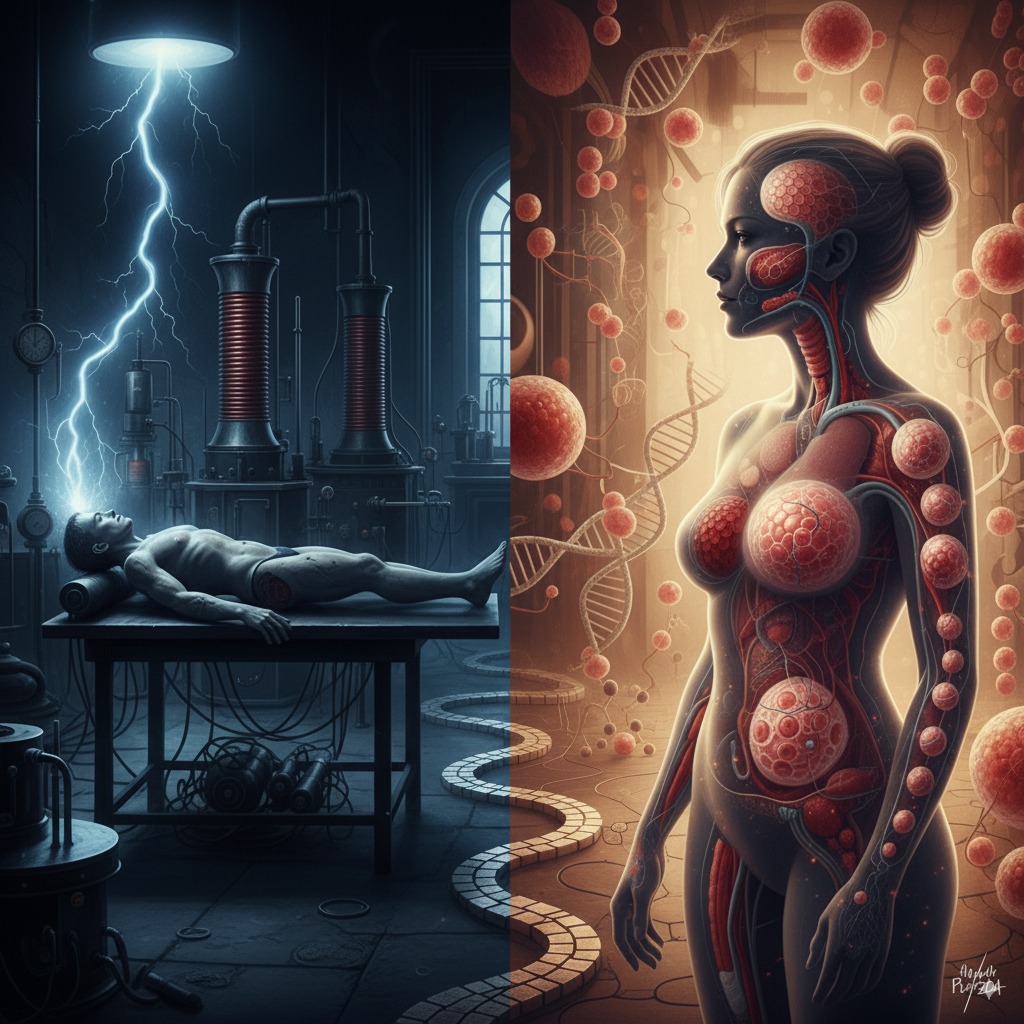
The ultimate expression of suicide was achieved by Mary Shelley (1797–1851) in her novel Frankenstein, written on the occasion of the contest with Lord Byron over who could write the most horrifying tale. Considering the era preceding the Industrial Revolution, nothing was more frightening than the discussion of the limits between the divine and the human, reopening the most elementary of philosophical questions: where do I come from, where am I going?
The being created by the scientist Victor Frankenstein was not a monster, except in his appearance, which was enough for him to be rejected by his creator and by everyone to whom he had the displeasure of showing himself. For this reason, he came to live in seclusion in the forest, where he could contemplate, from a distance, the daily life of a family of peasants, occasionally experiencing the generous company of a completely blind old man. But when he was seen by the others, he was attacked and banished on account of his features. Thus he devoted himself to pursuing his creator to demand the right he had been denied—that is, the right to be happy in the company of his fellow creatures. The scientist’s intransigent refusal caused the creature to be seized by rage and to murder his creator’s closest relatives. Having experienced the pain of loss, Victor Frankenstein feels punished by God and ends up reducing his life to the pursuit of revenge, dying out in the open. For the creature, the absence of his creator meant that he was utterly alone, without any hope of salvation. Lost amid intense suffering, he conspires for his own martyrdom.
Obviously, Shelley won the contest of dreadful tales. Worse than the supernatural is only that which concerns human nature. The capacity for self-destruction is inherent in everyone, and no one can feel immune to the reasons that lead us to anticipate the inevitable. Prudent is the one who does not tempt fate and does not falter in watching over his impulses, for many begin the suicidal process without even realizing it—whether through alcohol, drugs, ultra-extreme sports, excessive speed or overwork. They may call it escape, but in reality it is suicide.
The man who kills himself finds death less traumatic than life; he intends to escape the anguish that circumstances cause him; he destroys the body in order to annihilate the memories that degrade his thoughts and compromise all that lies ahead. With the exception of those who take their own lives unintentionally, in a hysterical attempt to draw attention, the suicide seeks to carry out the tragedy to perfection, often worthy of a cinematic spectacle, a funereal refinement that reminds us of some verses by Bocage: “when death robs me of the light, may a single moment gain what years have lost, may I learn to die what I knew not how to live.”
Modernity has caused suicide to move out of books and gain a place in films. It is impossible to forget the realism with which the problem is treated in Woody Allen’s September. Along the same lines, others gained more notoriety, such as the acclaimed Harold and Maude, …And Justice for All, Full Metal Jacket and Dead Poets Society. In music, the English band Pink Floyd shocked the world with scenes of self-flagellation, but it was their compatriots Judas Priest who ended up being taken to court, after a young man hanged himself while listening to a track from one of their most famous albums. In the nineties, the group Suicidal Tendencies even reached the Top Ten in the United States. Nevertheless, nothing compares to the way the subject has been coming to prominence today. As just one example, one of the most-watched series in the world in 2017, produced by Netflix, is called 13 Reasons Why, whose plot deals with a teenage girl who cuts her wrists as a result of the relentless bullying she suffered at school, along with other forms of violence.
The wave of suicides prompted by the Blue Whale game forced the taboo to be broken in the press. Since then, a series of articles has been published to spark debate. Research indicates that in Brazil suicide must now be understood as a public health issue, involving people of all ages, including even children as young as nine. In the Brazilian case, human misery reaches such levels that it becomes as difficult to know what leads a person to kill himself as to know what leads him to want to be alive. Of course, I am not referring to the group that corresponds to less than one percent of the population, which has a job, earns a decent salary, has health insurance and owns a home. I am thinking of the near-totality who, when employed, wonder how long they will have the privilege of holding down a job, live to pay their ordinary bills and keep their phones switched off so as not to be harassed by debt-collection companies. When they are out of work, they join the scramble to overturn the city’s trash cans in search of food.
It is true that financial ruin cannot be solely responsible for taking the shine off of life. Even among the wealthiest it is possible to find far more than thirteen reasons not to desire it. In that milieu, family disintegration is also on the rise, along with the strange pride of being detached from everything and everyone, except for whatever has market value. We must not deceive ourselves by what we see on Instagram or Facebook, on which we are not made of flesh and blood but of a shapeless mass whose main ingredient is futility. The photos that intrinsically send us messages of “look at my new car”; “see what a luxurious hotel I’m in,” “see how sexually irresistible I am,” “see how defined my abs are,” “see how fearless I am”—all these only confirm the need to camouflage the familiar void that leads to suicide.
A curious detail is that, for this evil that now afflicts us, we cannot count on criminal law as an ally. In recent years, Brazilians have been advocating the criminalization of every undesirable behavior, as if the threat of imposing a penalty were the solution to all sins. As it happens, under our national legislation suicide is not a crime, nor could it be. According to the dominant doctrinal current, for an act to attain the status of a criminal offense, it must be typical, unlawful and culpable—that is, defined by law, contrary to the legal order, and such that criminal responsibility can fall upon the perpetrator. The determination of whether an offense exists must be carried out by verifying the presence of these elements, rigorously in that order. Although suicide is considered an unlawful act—because no one is granted the right to kill himself, given that the State must protect life, an inalienable legal good—it is not typical. What is provided for in the Brazilian Penal Code is the conduct of one who induces, instigates or aids another to commit suicide. The individual who carries it out consequently extinguishes any punishability through death. The attempt is likewise not punishable, for if completed suicide is not a crime, its unsuccessful form could not be treated any differently. If the agent may do more, it necessarily follows that he may also do less. And for the sake of argument, if there were a legal loophole to punish the unsuccessful suicide, he would surely find the motive to renew the attempt with even greater precision.
The time has come to put society in the dock. When a young person is choked by the hangman’s noose or hurls himself in eternal flight from the top of a building, there is not a single innocent party. Anyone could have done something to try to prevent it. Silence in the face of another’s agony constitutes the proof that incriminates and condemns us. Whoever denies his share of the blame may see his own image reflected in the mirror smiling with disdain, like the character created by Albert Camus (1913–1960) in the book The Fall, who, crossing a bridge, hears the sound of a person plunging into the depths of the river, yet does nothing.
Depending on the conception we may have of life, it truly becomes impossible to understand suicide, and even more so to steer someone away from that path. To live means simply to breathe. With luck, we manage to love, and with even greater luck we attain the ecstasy of being loved. When the idea of what it means to live comes to have the same meaning as achieving success in the professional, romantic and financial spheres, suicide walks alongside us and waits for us around the bend.
Sergio Ricardo do Amaral Gurgel is a criminal defense lawyer at AMARAL GURGEL ADVOGADOS, an author with Editora Impetus, and a professor of Criminal Law and Criminal Procedural Law, e-mail: [email protected]