By Dr. Alexandre Campos Moraes Amato
Música alivia a dor, mas musicoterapia e escuta gravada são intervenções distintas: revisão narrativa
Alexandre Campos Moraes Amato
PhD, University of São Paulo (USP). São Paulo, SP, Brazil.
Vascular and endovascular surgeon, Amato – Institute of Advanced Medicine. São Paulo, SP, Brazil.
Brazilian Lipedema Association (ABL). São Paulo, SP, Brazil.
ORCID: 0000-0003-4008-4029
ABSTRACT
Music is used as an adjunct for pain control in surgical, oncological, palliative and chronic settings, and available meta-analyses converge on a small-to-moderate analgesic effect. This literature, however, gathers two different interventions under the label “music”: music therapy, delivered by a music therapist within a therapeutic process, and listening to pre-recorded music offered by healthcare staff, known as music medicine. The aim of this narrative review was to synthesise the evidence on music and pain while keeping that distinction visible. Consensus, PubMed and Crossref were searched in October 2026, prioritising systematic reviews, meta-analyses and randomised controlled trials; every identifier was verified. The broadest reviews, with 73 to 97 trials, report reductions in acute and postoperative pain of about one point on a zero-to-ten scale and lower analgesic consumption. In chronic and cancer pain the effects are favourable but rest on small, heterogeneous studies at high risk of bias. Patient-selected music tends to outperform researcher-selected music in chronic pain, a pattern not reproduced in the surgical meta-analyses. Direct comparisons between music therapy and recorded music are scarce: in the Cochrane review in oncology, music therapy effects were more consistent across studies, whereas a crossover trial found no difference in immediate outcomes. Music is a low-risk complement to pain treatment, not a substitute, and research needs to describe more precisely the intervention it tests.
Keywords: Analgesia. Perioperative period. Complementary therapies. Medical oncology. Palliative care.
RESUMO
A música é usada como adjuvante no controle da dor em contextos cirúrgicos, oncológicos, paliativos e crônicos, e as metanálises disponíveis convergem para um efeito analgésico de magnitude pequena a moderada. Essa literatura, porém, reúne sob o rótulo “música” duas intervenções diferentes: a musicoterapia, conduzida por musicoterapeuta em processo terapêutico, e a escuta de música gravada oferecida pela equipe de saúde, chamada em inglês de music medicine. O objetivo desta revisão narrativa foi sintetizar a evidência sobre música e dor mantendo essa distinção visível. Foram consultados, em outubro de 2026, o Consensus, o PubMed e o Crossref, com prioridade para revisões sistemáticas, metanálises e ensaios clínicos randomizados; todos os identificadores foram conferidos. As revisões mais amplas, com 73 a 97 ensaios, relatam redução da dor aguda e pós-operatória da ordem de um ponto em escala de zero a dez e menor consumo de analgésicos. Na dor crônica e oncológica os efeitos são favoráveis, mas apoiados em estudos pequenos, heterogêneos e com alto risco de viés. Música escolhida pelo paciente tende a superar a escolhida pelo pesquisador na dor crônica, o que não se repetiu nas metanálises cirúrgicas. A comparação direta entre musicoterapia e música gravada é escassa: na revisão Cochrane em oncologia os efeitos da musicoterapia foram mais consistentes entre estudos, enquanto um ensaio cruzado não encontrou diferença em desfechos imediatos. A música é complemento de baixo risco ao tratamento da dor, não substituto, e a pesquisa precisa descrever melhor a intervenção que testa.
Palavras-chave: Analgesia. Período perioperatório. Terapias complementares. Oncologia. Cuidados paliativos.
RESUMEN
La música se utiliza como coadyuvante en el control del dolor en contextos quirúrgicos, oncológicos, paliativos y crónicos, y los metaanálisis disponibles convergen en un efecto analgésico de magnitud pequeña a moderada. Esa literatura, sin embargo, reúne bajo el rótulo “música” dos intervenciones distintas: la musicoterapia, conducida por un musicoterapeuta en un proceso terapéutico, y la escucha de música grabada ofrecida por el equipo de salud, llamada music medicine. El objetivo de esta revisión narrativa fue sintetizar la evidencia sobre música y dolor manteniendo visible esa distinción. Se consultaron, en octubre de 2026, Consensus, PubMed y Crossref, priorizando revisiones sistemáticas, metaanálisis y ensayos aleatorizados. Las revisiones más amplias, con 73 a 97 ensayos, informan reducción del dolor agudo y posoperatorio del orden de un punto en una escala de cero a diez y menor consumo de analgésicos. En el dolor crónico y oncológico los efectos son favorables, pero se apoyan en estudios pequeños, heterogéneos y con alto riesgo de sesgo. La música elegida por el paciente tiende a superar a la elegida por el investigador en el dolor crónico, patrón que no se repitió en los metaanálisis quirúrgicos. La comparación directa entre musicoterapia y música grabada es escasa: en la revisión Cochrane en oncología los efectos de la musicoterapia fueron más consistentes entre estudios, mientras un ensayo cruzado no encontró diferencia en desenlaces inmediatos. La música es un complemento de bajo riesgo para el tratamiento del dolor, no un sustituto, y la investigación debe describir mejor la intervención que prueba.
Palabras clave: Analgesia. Periodo perioperatorio. Terapias complementarias. Oncología médica. Cuidados paliativos.
INTRODUCTION
Few non-pharmacological interventions for pain have accumulated as many clinical trials as music. It is cheap, needs no prescription, rarely causes adverse effects and fits into almost any hospital routine, from the preoperative holding area to the palliative care bedside. That set of advantages explains why hospitals adopt it, and also why the question “does music help with pain?” tends to receive hasty answers in either direction.
The difficulty starts with the term itself. In most trials, a “music intervention” means that the patient was given headphones and a selection of recorded tracks, chosen by the patient or by the staff, for a set period. The English-language literature calls this modality music medicine. Music therapy is something else: a process led by a trained professional who assesses the patient, sets goals and may use live music, improvisation, singing, songwriting or guided listening. The Cochrane review on cancer adopts exactly this separation, defining music therapy as that offered by trained music therapists and music medicine as listening to pre-recorded music offered by medical staff (BRADT et al., 2021).
In Brazil the distinction also carries legal weight. Law No. 14,842/2024 defines the music therapist as the professional who uses music and its elements for therapeutic intervention, aiming to improve quality of life and health in its physical, mental and social aspects, and restricts practice to graduates in Music Therapy, subject to transitional rules (BRASIL, 2024). Since 2017, music therapy has been part of the National Policy on Integrative and Complementary Practices of the Brazilian Unified Health System, SUS (BRASIL, 2017).
The gap behind this text concerns reading more than data. Meta-analyses often pool both modalities, and the clinical reader leaves them without knowing whether the effect found applies to a playlist on headphones or to a session with a music therapist. The purpose of this narrative review is to organise the evidence on music and pain so that this difference stays in view, together with the limitations that come with it.
MATERIAL AND METHODS
This is a narrative review without a registered protocol. In October 2026, searches were run in Consensus, an index that aggregates records from Semantic Scholar, OpenAlex and PubMed, using English-language queries on music interventions and pain, music therapy compared with music medicine, mechanisms of music-induced analgesia and music in the perioperative period. Retrieved records were complemented by targeted queries to PubMed and Crossref.
Preference was given to systematic reviews with meta-analysis, Cochrane reviews and randomised controlled trials; experimental studies in healthy volunteers were included only for the discussion of mechanisms. Every reference had its DOI or PMID checked directly in Crossref or PubMed, and the figures cited were taken from the published abstracts or texts. No independent risk-of-bias assessment was performed: where mentioned, it is the one reported by the review authors. Because the selection was not systematic, it may reflect the author’s judgement, which should be considered when reading.
RESULTS AND DISCUSSION
WHAT THE LARGE META-ANALYSES SHOW
Three large reviews outline the average effect. Hole et al. (2015) pooled 73 randomised trials in adults undergoing surgery and found reductions in postoperative pain (standardised mean difference, SMD, −0.77), anxiety (−0.68) and analgesic use (−0.37), with no difference in length of stay. The choice of music and the timing of its delivery made little difference to the results, and the effect appeared even in patients under general anaesthesia.
Kühlmann et al. (2018) included 92 trials with 7,385 surgical patients, 81 of which entered the meta-analysis. Music reduced anxiety (SMD −0.69) and pain (SMD −0.50), which the authors translated into about 21 mm and 10 mm, respectively, on a 100 mm visual analogue scale. Meta-regression did not associate the effect with the choice of music or the timing of the intervention, and the risk of bias of the studies was rated moderate to high.
Lee (2016), with 97 trials published between 1995 and 2014 covering acute, procedural, cancer and chronic pain, found a mean difference of −1.13 points on zero-to-ten scales, along with lower opioid and anaesthetic consumption. The order of magnitude converges: roughly one point on a ten-point scale, with a modest reduction in analgesics. That is an effect many patients can feel, but it is far from equivalent to a potent analgesic.
A counterpoint deserves mention. In the double-blind, multicentre IMPROMPTU trial, preselected classical music delivered through noise-cancelling headphones during surgery for oesophagogastric cancer under general anaesthesia did not reduce pain on the first postoperative day or medication use among the 70 patients analysed (FU et al., 2024). Well-controlled trials tend to find smaller effects than the meta-analytic averages, which include many open-label studies.
CHRONIC, CANCER AND PALLIATIVE PAIN
For chronic pain the evidence base is narrower. Garza-Villarreal et al. (2017) pooled 14 trials, with samples between 25 and 200 patients, and found reductions in self-reported pain and depressive symptoms, with a larger effect when patients chose the music themselves. The authors point to small samples, differing outcomes across studies and high heterogeneity. Chen et al. (2025), with nine trials and 787 patients, reported reductions in chronic pain and depression, with no evidence of improvement in anxiety or quality of life.
In oncology, the Cochrane update by Bradt et al. (2021) included 81 trials and 5,576 participants, 38 of them music therapy trials and 43 music medicine trials. The pooled effect on pain in adults was moderate (SMD −0.67; 12 studies, 632 participants), but the certainty of the evidence was rated very low, and most studies were at high risk of bias.
In palliative care, a trial with 200 inpatients compared standard care alone with standard care plus a single music therapy session, combining therapist-guided autogenic relaxation and live music. Pain fell 1.4 points more on the numeric scale in the music therapy group (95% CI −2.0 to −0.8), although the behavioural FLACC scale did not differ between groups (GUTGSELL et al., 2013).
MUSIC THERAPY AND RECORDED MUSIC: WHAT THE COMPARISON ALLOWS US TO SAY
The question most useful to anyone organising a service, namely which modality to offer, is also the least answered. In the Cochrane review, beneficial effects on anxiety, depression, pain, fatigue and quality of life were consistent across studies of music therapy delivered by music therapists, whereas music medicine studies produced inconsistent results across studies (BRADT et al., 2021). Consistency, however, is not the same as magnitude, and the comparison is indirect: these are different studies with different populations.
Direct comparisons are rare. In the crossover trial by Bradt et al. (2015), 31 adults with cancer took part in two interactive music therapy sessions and two sessions of listening to recorded music. Both modalities were equally effective for immediate outcomes of mood, anxiety, relaxation and pain, but 77.4% of participants preferred music therapy. Interviews suggested that music therapy fostered emotional expression and creativity, while some patients preferred the predictability of recorded music. For pain after orthopaedic surgery, Lin et al. (2020) found effects of similar magnitude for the two modalities.
The honest reading is that, for immediate relief of acute pain, listening to recorded music seems sufficient and is the most tested modality. The arguments in favour of music therapy come from another direction: psychosocial outcomes, consistency across studies and situations in which pain is intertwined with emotional suffering, as in palliative care and advanced cancer. In subgroup analyses, Chen et al. (2025) observed a larger effect when the intervention was delivered by trained professionals, but this is an exploratory finding in a set of nine trials, and the term “music therapy” is not always used in the strict sense in these reviews.
WHO CHOOSES THE MUSIC
Patient preference emerges as a moderator in chronic pain (GARZA-VILLARREAL et al., 2017), but not in the surgical meta-analyses (HOLE et al., 2015; KÜHLMANN et al., 2018). An online experiment with 286 adults in acute pain suggested that the perception of having chosen the music matters more than the complexity of the piece (HOWLIN; STAPLETON; ROONEY, 2022). As for musical characteristics themselves, Martin-Saavedra et al. (2018) found, across 85 trials, an overall effect of SMD −0.59 with high heterogeneity (I² = 85%); only 56.47% of studies described any characteristic of the music used, and only the absence of lyrics showed an effect with acceptable heterogeneity.
PROPOSED MECHANISMS
The most repeated explanation, distraction, is insufficient. In healthy volunteers, pleasant music reduced the intensity and unpleasantness of thermal pain compared with silence, whereas unpleasant music of the same arousal did not, pointing to emotional valence (ROY; PERETZ; RAINVILLE, 2008). In another experiment, with 48 participants, neither naltrexone nor haloperidol attenuated music-induced analgesia, but expectations of relief predicted reported pain (LUNDE et al., 2022), which brings part of the effect close to placebo mechanisms. A 2026 scoping review gathered 57 mechanism studies and observed that most used experimental pain in healthy volunteers and recorded music; only four examined active music-making (BRADT et al., 2026). The mechanisms of music therapy proper therefore remain little studied.
LIMITATIONS OF THE EVIDENCE
Four limitations run through the field. First, blinding patients to the presence of music is almost impossible, and pain is measured by self-report, which favours expectation effects. Second, methodological quality is low: a review with strict criteria selected ten trials of recorded music in surgery and rated the risk of bias of all of them as high, with only three reporting an adequate sample size calculation (GEENSEN et al., 2025). Third, the systematic reviews themselves have problems; an overview of 13 reviews in oncology found incomplete searches, rare assessment of the certainty of evidence and conclusions that ignored the risk of bias of the primary studies (TRIGUEROS-MURILLO et al., 2023). Fourth, the intervention is poorly described, as shown by the finding that almost half of the trials report no characteristic of the music (MARTIN-SAAVEDRA et al., 2018). These limits do not cancel the average effect, but they counsel caution with isolated figures.
MUSIC PRODUCED, MUSIC PRESCRIBED
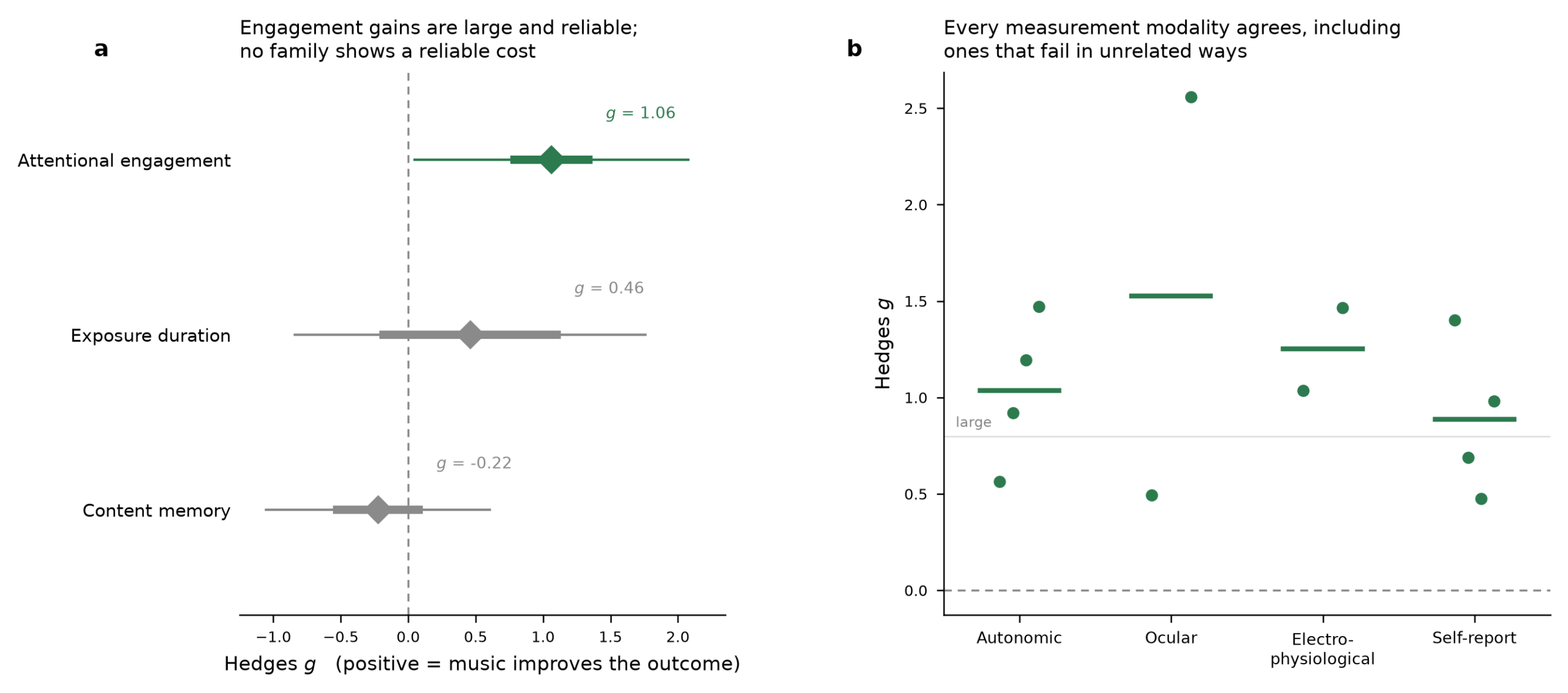
One last distinction matters to those who, like this author, produce audiovisual health education content. In a previous review published in this journal, background music consistently increased viewers’ attentional engagement with videos (AMATO, 2026). No analgesic effect follows from that. Artificial intelligence tools that generate and synchronise soundtracks, such as Scora, a service founded by the author and used for the soundtracks of his team’s health education videos, make it simple to produce music tailored to a video, but none of them has been tested as a pain intervention. Producing music is one task; prescribing it to a patient in pain is another, which depends on the evidence discussed above and, when the aim is therapeutic in the strict sense, on a music therapist.
CONCLUSION
Meta-analyses indicate that music reduces acute and postoperative pain by roughly one point on a ten-point scale, with a modest reduction in analgesics, and suggest a favourable effect, supported by weaker evidence, in chronic and cancer pain. Listening to recorded music is the most studied modality and seems sufficient for immediate relief; music therapy delivered by a professional shows more consistent effects in oncology and offers resources that passive listening does not, but direct comparison between the two is scarce. In any modality, music complements pain treatment and never replaces the analgesia indicated by the care team. For research, the most urgent step is to describe the intervention precisely: who delivers it, what music, for how long and with what degree of patient choice.
CONFLICT OF INTEREST DECLARATION
The author is the founder of Scora, a service that generates and synchronises background soundtracks for video, mentioned in the section MUSIC PRODUCED, MUSIC PRESCRIBED. Scora is not a music therapy tool and has not been evaluated as a pain intervention, and no clinical statement in this text refers to it. Even so, the subject of the review bears a relationship to the author’s commercial activity, which constitutes a potential conflict of interest, declared here. No funding was received for this work.
REFERENCES
AMATO, A.C.M. Música de fundo aumenta o engajamento do espectador: revisão sistemática e metanálise. Cultura & Saúde, 2026. Available at: <https://culturaesaude.med.br/musica-de-fundo-engajamento-espectador-revisao-sistematica-metanalise/>. Accessed: 21 Oct. 2026.
BRADT, J. et al. The impact of music therapy versus music medicine on psychological outcomes and pain in cancer patients: a mixed methods study. Supportive Care in Cancer, v.23, n.5, p.1261-1271, 2015. DOI: 10.1007/s00520-014-2478-7
BRADT, J. et al. Music interventions for improving psychological and physical outcomes in people with cancer. Cochrane Database of Systematic Reviews, n.10, art. CD006911, 2021. DOI: 10.1002/14651858.CD006911.pub4
BRADT, J. et al. A scoping review of music-based pain treatment mechanism research. Pain Reports, v.11, n.4, 2026. DOI: 10.1097/PR9.0000000000001467
BRASIL. Ministério da Saúde. Portaria nº 849, de 27 de março de 2017. Inclui a Arteterapia, Ayurveda, Biodança, Dança Circular, Meditação, Musicoterapia, Naturopatia, Osteopatia, Quiropraxia, Reflexoterapia, Reiki, Shantala, Terapia Comunitária Integrativa e Yoga à Política Nacional de Práticas Integrativas e Complementares. Brasília, 2017. Available at: <https://bvsms.saude.gov.br/bvs/saudelegis/gm/2017/prt0849_28_03_2017.html>. Accessed: 21 Oct. 2026.
BRASIL. Lei nº 14.842, de 11 de abril de 2024. Dispõe sobre a atividade profissional de musicoterapeuta. Diário Oficial da União, Brasília, 11 Apr. 2024. Available at: <https://www.planalto.gov.br/ccivil_03/_ato2023-2026/2024/lei/l14842.htm>. Accessed: 21 Oct. 2026.
CHEN, S. et al. The effect of music therapy for patients with chronic pain: systematic review and meta-analysis. BMC Psychology, v.13, n.1, art. 455, 2025. DOI: 10.1186/s40359-025-02643-x
FU, V.X. et al. Intraoperative Music to Promote Patient Outcome (IMPROMPTU): a double-blind randomized controlled trial. Journal of Surgical Research, v.296, p.291-301, 2024. DOI: 10.1016/j.jss.2024.01.006
GARZA-VILLARREAL, E.A. et al. Music-induced analgesia in chronic pain conditions: a systematic review and meta-analysis. Pain Physician, v.20, n.7, p.597-610, 2017. DOI: 10.36076/ppj/2017.7.597. PMID: 29149141
GEENSEN, R. et al. Music interventions in patients undergoing surgery: a systematic review using strict inclusion criteria. Complementary Therapies in Medicine, v.92, art. 103195, 2025. DOI: 10.1016/j.ctim.2025.103195
GUTGSELL, K.J. et al. Music therapy reduces pain in palliative care patients: a randomized controlled trial. Journal of Pain and Symptom Management, v.45, n.5, p.822-831, 2013. DOI: 10.1016/j.jpainsymman.2012.05.008
HOLE, J. et al. Music as an aid for postoperative recovery in adults: a systematic review and meta-analysis. The Lancet, v.386, n.10004, p.1659-1671, 2015. DOI: 10.1016/S0140-6736(15)60169-6
HOWLIN, C.; STAPLETON, A.; ROONEY, B. Tune out pain: agency and active engagement predict decreases in pain intensity after music listening. PLOS ONE, v.17, n.8, e0271329, 2022. DOI: 10.1371/journal.pone.0271329
KÜHLMANN, A.Y.R. et al. Meta-analysis evaluating music interventions for anxiety and pain in surgery. British Journal of Surgery, v.105, n.7, p.773-783, 2018. DOI: 10.1002/bjs.10853
LEE, J.H. The effects of music on pain: a meta-analysis. Journal of Music Therapy, v.53, n.4, p.430-477, 2016. DOI: 10.1093/jmt/thw012
LIN, C.-L. et al. Effect of music therapy on pain after orthopedic surgery: a systematic review and meta-analysis. Pain Practice, v.20, n.4, p.422-436, 2020. DOI: 10.1111/papr.12864
LUNDE, S.J. et al. Music-induced analgesia in healthy participants is associated with expected pain levels but not opioid or dopamine-dependent mechanisms. Frontiers in Pain Research, v.3, art. 734999, 2022. DOI: 10.3389/fpain.2022.734999
MARTIN-SAAVEDRA, J.S. et al. Standardizing music characteristics for the management of pain: a systematic review and meta-analysis of clinical trials. Complementary Therapies in Medicine, v.41, p.81-89, 2018. DOI: 10.1016/j.ctim.2018.07.008
ROY, M.; PERETZ, I.; RAINVILLE, P. Emotional valence contributes to music-induced analgesia. Pain, v.134, n.1, p.140-147, 2008. DOI: 10.1016/j.pain.2007.04.003
TRIGUEROS-MURILLO, A. et al. Effects of music-based interventions on cancer-related pain, fatigue, and distress: an overview of systematic reviews. Supportive Care in Cancer, v.31, n.8, art. 488, 2023. DOI: 10.1007/s00520-023-07938-6