I see several different initiatives aimed at increasing surgical fees in vascular surgery. Here I will speak specifically about varicose veins, the flagship of our specialty. SBACV Rio launched its Vascular Fee Schedule (ROL da Vascular) in 2018, now in its 4th edition, and it was congratulated by the AMB in a letter to the board, but it also draws opposing opinions (I wrote this before recognition by the national society). At the same time, there are coding initiatives and different negotiations by various other regional chapters, as well as groups with different ideas. The approach has differed from group to group, although the objective is more or less the same: increasing final surgical fees. I say more or less because we have to exclude from these groups those who, for other reasons, have an interest in reducing or holding down surgical fees because they belong to or work for insurers that would benefit from this, and there are those who, out of personal grudges, lose sight of the larger objectives. And we have to exclude any final financial gain that comes not from surgical fees but from the sale of materials or hospital services. That is why disclosure is important here: I do not work for any health insurer, I have been reducing my in-network contracts precisely because I disagree with the remuneration, and I have focused on medical reimbursement and de-hospitalization. The ideal focus is the physician–patient relationship, with the goal of a good outcome for the patient. Whenever you are about to hear someone on this subject, ask for a disclosure before their position.
The real initiatives that genuinely aim to increase surgical fees rest on the following premises: blocking the inclusion of new procedures in the ANS coverage list (ROL), raising the minimum fee schedule for payment to the physician, contracting directly with hospitals, group negotiations, and increasing the number of codes involved in the procedure. I will discuss each of these.
Regarding the blocking of new procedures from the ANS coverage list, the new techniques of laser and radiofrequency thermal ablation are not automatically deemed mandatory because of NORMATIVE RESOLUTION — RN No. 387, OF OCTOBER 28, 2015, in its Article 12, which states: “procedures performed by laser, radiofrequency, robotics, neuronavigation or another navigation system, endoscopies, and minimally invasive techniques will only have guaranteed coverage when so specified in Annex I, according to the contracted coverage tier.” In other words, laser and radiofrequency only enter the coverage list if duly specified. There is an unconscious desire — and in some cases an all-too-conscious one — to keep thermal ablations in this state, so that, with no coverage by insurers, the physician feels entitled to charge the patient an extra amount because the procedure is not covered. It is now more than clear that thermal ablations are preferable to stripping (I will not go into technical matters here), and we, as physicians, must encourage the adoption of technologies beneficial to patients, not restrict them for our own benefit. To argue against including the technique in the coverage list is to fail to defend the patient’s health. Just as with video laparoscopy, which took time to be accepted until it became routine, so it will be with thermal ablations. Moreover, when charging an extra fee for the use of laser in surgery, is the physician charging for hospital expenses or for professional fees? We must indeed encourage the adoption of techniques beneficial to patients. I am not saying we should give up decent fees. But for a physician to charge hospital expenses, they must take on the de-hospitalization, because a patient cannot have two hospital bills — one from the physician who brings the laser and fiber, and another from the hospital as an open account billed to the insurer. It can be done… but it is not a sustainable situation. As many have already realized, hospitals live off MATMED (materials and medications) and have no interest in leaving things as they are; they will progressively make this arrangement more difficult. It is a fight the physician does not have the strength to win: physician vs. hospital, physician vs. insurer, and, in this case, working against public health, it would also be physician vs. patient. The same recently happened with the adoption of foam techniques, and there was a general outcry demanding higher values. If health in Brazil is a right of all and a duty of the state, then, once again, fighting against the adoption of beneficial techniques is a losing battle.
Regarding raising the minimum fee schedule for payment to the physician, there are some problems: in Brazil, the minimum schedule often becomes the maximum value. A good example is the ANS coverage list itself, which is a schedule of procedures with mandatory minimum coverage — insurers could cover procedures not included in it, but few have this as a policy. In this case the minimum list became the maximum list. And by setting a minimum value, there is a leveling down that does not reflect each individual’s local realities. It is clear that values can and should differ among states, cities, and regions, and this should occur through the free market, the law of supply and demand. Any attempt to prevent the market from acting on these values is union-like, cartelizing policy. The CBHPM, which has a method for valuing procedures, was at one point characterized as a cartel. See (https://www.conjur.com.br/dl/trf-decide-cfm-nao-tabelar-honorarios.pdf) “RESOLUTION. FEE SCHEDULE. COMPETENCE. COERCION. 1 – The Medical Councils cannot impose a fee schedule (CBHPM), on pain of violating freedom of contract. 2 – The setting of minimum professional fees by the Federal Council does not fall within the powers granted by Law No. 3,268/57, even if done under the guise of imposing a minimum, ethical standard of remuneration for medical procedures, for the Supplementary Health System.” Thus any attempt to standardize values may be seen as cartelization. In this case the fight is between societies vs. insurers, but the way out does not lie there.
In the case of contracting directly with hospitals, the physician transfers all bargaining power to the hospital, letting it negotiate on their behalf, but obviously the financial interests are not the same. Hospitals will tend to raise the values of hospital expenses, neglecting or even working against professional fees. Those who outsource negotiation to hospitals are often happy to be in large centers with high bargaining power; they feel valued and important, but they forget that they have become mere products in those centers, and that they can easily be replaced by “cheaper” or “more controllable” products, losing their decision-making power. Any company wanting to increase profit will act on two factors: raise the selling price and lower its costs. In this situation, the physician falls into the category of lowering the product’s cost, increasing the profit margin. It is that simple. In this case, convenience, ego, tradition, and outsourcing end up becoming the ultimate enemy of the very physician who, before long, will be wondering how another, cheaper team took over their post if their own service is of good quality — along with hundreds of other laments I have already heard.
Group negotiations work well in more limited regions, involving a manipulation of the law of supply and demand. Although effective, they are still cartelization and subject to being characterized as such. The market shows no mercy: where there is a lot of a “product” available, the price drops. As a former presidential candidate once compared physicians to salt: “White, cheap, and everywhere.” We cannot close our eyes to reality, because it will run over everyone. Many medical schools have opened. Many physicians will enter the labor market, and yes, many will be working in our specialty. The proliferation of specializations, graduate programs, and courses may have the opposite of the intended effect and open the market to non-specialists. And obviously this will affect everyone’s fees. Any attempt to manipulate the market at this point is self-limiting; it may last for a while, but cheaper alternatives will naturally emerge. We must accept this reality and direct our efforts where they can truly be productive: in requiring qualification, in the technical requirements to practice, and in improving outcomes. Yes, at some point the market will shift from a pay per service system to a pay per result system. Where I currently see a transfer of business risk: the insurer, which by definition profits by calculating risks, would pass the responsibility for risk to the hospital, securing its own position in the business — an incredible distortion of reality, and, worse still, it is being delivered wrapped up like a gift, but it is a Trojan horse in the medium and long term.
Lastly, I turn to increasing the number of codes involved in the procedure, which, in my view, is the best thing to do in the short term. For everyone involved in varicose vein treatment, it is very clear that there are easier cases and more difficult cases. Some involve more work and others less. Veins that are treated in one way and others in another. But despite this, and despite there being several codes for varicose veins in the AMB92 (yes, many insurers still rely on it even though the schedule’s name and code have changed), there is still a tendency to reduce all varicose vein treatment to a single code: TUSS 30907136
Referring to the procedure: Varicose veins – surgical treatment of two limbs.
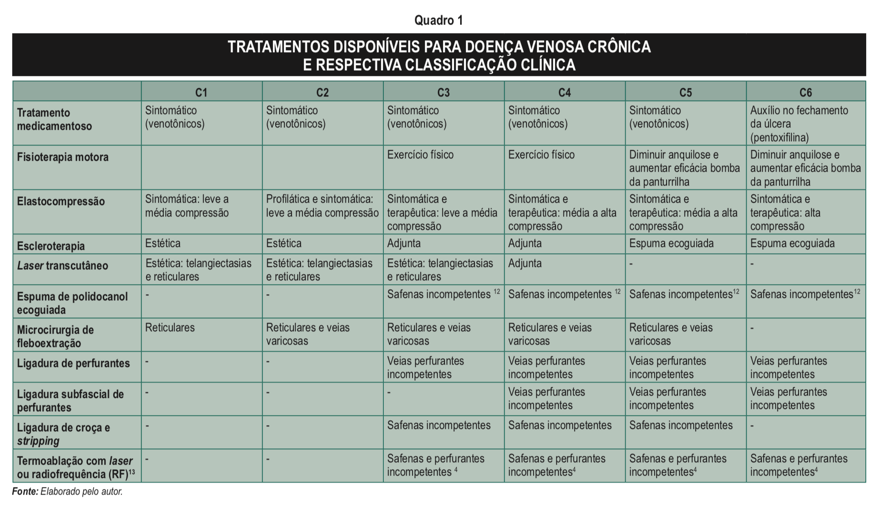
Figure 1 – Example of the complexity of treatments available given the wide clinical variation of venous disease (Amato. ACM. DOENÇA VENOSA CRÔNICA: VARIZES, INSUFICIÊNCIA VENOSA E REFLUXO VENOSO In: SECAD 2018)
Although it is a complex disease with an enormous range of clinical presentations (Figure 1), there is an evident oversimplification of the problem, classifying them all as “bilateral varicose vein surgery.” For the hospital it makes no difference, because the bill is drawn up on an open-account basis and the fees do not change with the coding used, and the hospital’s interest is that the surgery take place, regardless of professional fees. In short, if the surgery is easily authorized with one code, there is no reason for the hospital to fight for an additional code, which is hard to get approved, if the hospital values do not change drastically. Some colleagues also specialize in microsurgeries performed with the billing weight of major surgery, benefiting from the surgical code. But these same colleagues would benefit more by charging per vein removed and by de-hospitalization. I recall that the following codes exist in the TUSS, many of them underused:
TUSS: 30907136 Varicose veins – surgical treatment of two limbs
TUSS: 30907144 Varicose veins – surgical treatment of one limb
TUSS: 30907101 Surgical treatment of varicose veins with lipodermatosclerosis or ulcer (one limb)
TUSS: 30907071 Fulguration of telangiectasias (per group)
TUSS: 30907063 Sclerotherapy of veins – per session – without supplies
TUSS: 40902064 Intraoperative color Doppler
TUSS: 30907012 Restoration of venous flow or Venous restoration surgery with bypass grafts in cavities (note here the “or” in the description)
SBACV Rio’s coverage list recommends using the two codes for varicose vein surgery: 30907136 Varicose veins – surgical treatment of two limbs, and 30907012 Restoration of venous flow. In this case, there is no discussion of the values to be charged, only of the codes requested, avoiding the cartelization that has occurred or may occur in other modes of negotiation. The codes refer to surgical weights or CH values, which highlight the complexity of the procedure relative to others. Although I agree with acting on the codes to add value to the treatment, I believe this still preserves the aspect of oversimplification — that is, all patients are the same, and so are the treatments. In earlier editions, the publication cited values, falling back into the error of the minimum schedule becoming the maximum. With no values in the schedule, negotiation falls to the professional, not to the society, but is backed by the complexity attributed to the procedure. The technical difference between a microsurgery and a saphenectomy is also very evident; therefore, we should add value to our work by showing the complexity of the disease and its various presentations, which require different treatments. Currently, insurers understand the bilateral varicose vein surgery code to include sclerotherapy, Müller phlebectomy, microphlebectomy, perforator ligation, saphenectomy by stripping, flow redirection in CHIVA and ASVAL, among others, because, the last time I heard an auditor speak, it was the “insurer’s understanding.” This is not to mention the techniques not yet listed in the ANS coverage list. If we do not take a firm stand, and if there are internal disagreements, there will always be a different “understanding” that benefits whoever holds the greater power in the negotiation — the insurer. Each of the techniques used in surgery must be duly remunerated and valued by the surgeon themselves, who should not underrate their work by bundling every technique and practice into a single package. Or, if they do bundle it, they must understand that it is no use resorting to subterfuge for “off-the-books” charges.
There is no manual for interpreting the code schedules, and that is where we should act.
Societies and groups should strengthen themselves on this point, because the interpretation of the schedule should belong to those who understand the subject best, the specialist. Otherwise we will be at the mercy of the “understanding” of the insurer or its auditor, whose sole objective is to reduce costs for the insurer and not to carry out the patient’s treatment.
When I see colleagues asking the society to negotiate values with insurers, I understand the desperation and the acknowledgment of low bargaining power, trying to transfer the responsibility for negotiation to a professional body with theoretically greater bargaining power. But that is not the responsibility of a medical society; it is that of a union. And, moreover, this theoretical bargaining power does not exist. In every negotiation, the advantage lies with whoever holds time, power, and information, and medical societies possess none of these characteristics in the negotiation. Consider: time — the one in a hurry to show results is the society, while the insurers want to delay any change as long as possible; information — the society does not know the demands of that insurer’s clientele; power — the insurers hold the decisive financial power. Any increase obtained in these negotiations would be mere handouts, or even dirty tactics to curb or delay other negotiations.
The same people who seek out a union’s services to improve and mediate negotiation with their “employers” also celebrate the end of the mandatory union contribution and, therefore, of their negotiating “strength.” Which is contradictory to say the least, and, curiously, they ask another institution to play that role. The physician in Brazil wants the opportunities of capitalism with the union power of socialism. It is not the physician’s fault. The system is complex, with the socialized (not socialist) medicine of the SUS existing alongside the capitalist medicine of the private market. It is difficult for two different realities to coexist. It is no use wanting the security of a tenured public employee within a private-sector employment contract, and it is no use wanting the financial opportunities of the private system within a public system. But as I said, this article is only about varicose veins and I will not dwell on it. The only acceptable position for the physician, as an individual and not as a group, is the desire to improve the health of all their patients, whatever the cost, and to add more value to their work, making clear the complexity of what they do and thus increasing their surgical fees. With recognition. Vascular societies and groups should unite to add value to professional work, avoiding the oversimplification of a complex treatment and better qualifying professionals.
Let us leave the only ones capable of interpreting the vascular codes — the vascular surgeons — to do so, and take this ambiguous interpretation out of the hands of the insurers.