William Moffitt Harris
Retired Professor and Doctor of the School of Public Health, University of São Paulo (USP)
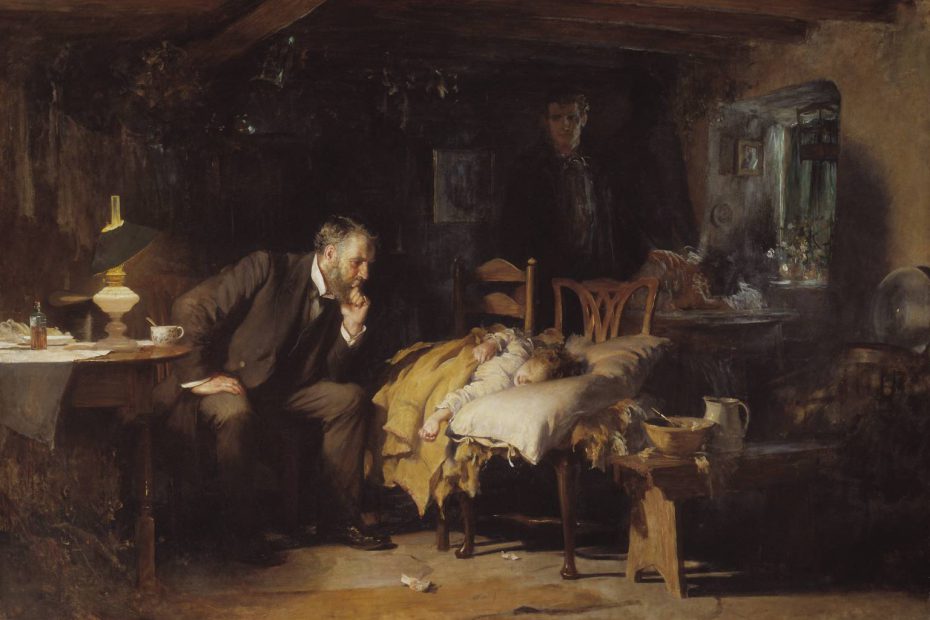
The original oil-on-canvas painting of “The Doctor,” measuring 166.3 cm by 241.9 cm, painted in 1891, is on display at the Tate Gallery in London. It was commissioned by Queen Victoria from Sir Henry Tate, who in turn commissioned Fildes to paint it for £3,000. In 1894, he donated it to the National Gallery of British Art. Beside the painting is the following text: *
“Fildes’s masterpiece, which became instantly popular, was inspired by the death of his son on Christmas Day 1877 and by the professional devotion of the physician who attended him. He gave his painting a happier ending, for it shows the moment, at sunrise, when the child shows the first signs of recovery. Fildes took great pains to make the painting thoroughly convincing, building a cottage interior inside his studio and positioning the cottage window opposite the window of the studio. He would rise very early each day in order to paint by the morning light as it began to fill the room.”
Luke Fildes (as he is best known) was born in Liverpool and spent much of his youth in Chester, on the border with Wales. He studied art at the South Kensington schools (1863) and at the Royal Academy (1866). He soon distinguished himself among the finest English painters with “Applicants for Admission to a Casual Ward” (1874), “The Widower” (1876), “The Return of the Penitent” (1876), “The Village Wedding” (1883), and “An Al-fresco Toilette” (1889). He also painted many pictures of Venetian life and many notable portraits, among them the coronation of King Edward VII, Queen Alexandra, and many other figures of noble descent.
He met Charles Dickens in his youth and illustrated the cover of Dickens’s last (unfinished) work, “The Mystery of Edwin Drood” (1870). He was also strongly drawn to the pressing social themes of the day. These influenced him considerably in his work as a painter and, earlier, as a wood engraver. He was greatly praised for the Dickensian character of his study in his work. The painting “Applicants for Admission to a Casual Ward,” the picture of the year, required a policeman and railings to keep back the crowd of the curious and admirers. He was insistent on portraying people from the street authentically.
Samuel Luke Fildes was elected an Associate of the Royal Academy in 1879 and a full Academician, with the painting “The Schoolgirl,” in 1887. He received the honorary title of Knight from King Edward VII in 1906.
His works are scattered across various English museums (the Tate Gallery, Royal Holloway College, the Russell-Cotes Museum in Bournemouth, the museums of Brighton and Warrington, and the Lady Lever Art Gallery in Port Sunlight). Many of his works are unknown to the general public, being in private collections owing to the fact that he was also a skilled portraitist, much appreciated by traditional British families. He earned a great deal of money through his talent and diligence, becoming one of the wealthiest painters in England.
He was so insistent on exactness in his art that he created problems with some of his sitters. It is said that Cecil Rhodes was so furious with his portrait that he sent a note with the cheque saying that, as soon as the painting arrived, he would burn it. To this reaction from the by-then-already-famous explorer, Fildes responded by returning the cheque and keeping the painting.
Bibliography consulted: 1) BINDMAN, David (Ed.) – The Thames and Hudson Dictionary of British Art. London, Thames and Hudson Ltd, 1995. p.87 2) TREUHERZ, Julian – Victorian Painting. London, Thames and Hudson Ltd, p. 160, 180-184, 1993. 3) Entries on Sir Samuel Luke Fildes in The Encyclopædia Britannica, 13th ed., 10: 339, 1926, and in BENÉT, William Rose – The Reader’s Encyclopedia, p.380, 1948. 4) the following websites www.spartacus.schoolnet.co.uk/fildes.nun (offline), www.allaboutart.com.enlarge.asp.site.aaa/#pain/NY/large (offline)
* Free translation; it was copied by my brother Walter Whitton Harris, an orthopedic surgeon in São Paulo, during one of his wanderings in London, from where he brought back a photograph of the painting on a postcard.