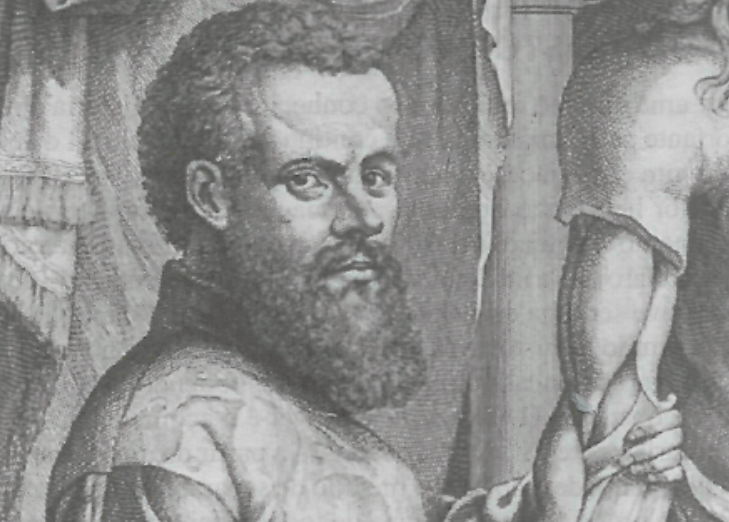
Andreas Vesalius, born in 1514 in Brussels, attended the universities of Louvain, Paris, and Padua, graduating in medicine at Padua in 1537. Before him, several scholars had studied and described human anatomy. Herophilus of Alexandria, in the fourth century BC, saw his observations burned. Galen, in the second century AD, had his anatomical observations so revered that to disagree with them was heresy—even though they contained many erroneous descriptions based on animals. Mondino DeLuzzi, with his Anothomia—published in 1478 and written in 1316—began to perform dissections, yet retained Galen’s errors. Berengario da Carpi, in 1521, holder of the chair of surgery and anatomy at Bologna, published his book Commentaries on the Anothomia, based on human dissections; although these were rough diagrams, he corrected some of Galen’s mistaken anatomical conceptions.
Andreas Vesalius revolutionized the study of anatomy by turning over bones in cemeteries, dissecting cadavers in his own room, and publishing, in 1538, the Tabulae anatomicae sex—a work that, for the first time in centuries, corrected various small errors of Galen, with artistic drawings of human bones and muscles. He changed the very conception of anatomy, which had been taught at a safe distance from the cadaver while reading Galen’s texts, dissecting the bodies himself, without gloves, antiseptics, or preservation solutions. At the age of 29, in 1543, he published De humani corporis fabrica, libri septem, better known as the Fabrica, the greatest medical book ever published, which astonished the community for its grandeur and content. He pointed out Galen’s persistent errors, displeasing many of his contemporaries. Book 1 is devoted to the study of the bones, Book 2 to the muscles, Book 3 to the arteries and veins, Book 4 to the nervous system, Book 5 to the abdominal organs, Book 6 to the heart and lungs, and finally Book 7 to the brain. He also published the Epitome, a condensation of the Fabrica, for students to use at the dissection table.
His students and successors likewise carried on with anatomical discoveries. Realdo Colombo (1512–59), Vesalius’s successor at Padua, accurately described the circulation of blood from the right ventricle to the left ventricle of the heart, passing through the lungs and the heart itself, publishing De re anatomica. Gabriel Fallopius (1525–62), Colombo’s successor, described anatomical structures not described by Vesalius, such as the female organs, giving the first description of the ovary and the uterine tubes that now bear his name, and assigning names to the vagina, placenta, and clitoris, which had previously had none. Bartolomeo Eustachi (1520–74) wrote a splendid manuscript in 1552, forgotten for 150 years in the Vatican Library and published in 1714 by the cardiologist Giovanni Lancisi; besides pointing out errors in the Fabrica, he also made observations neglected by Vesalius, correctly describing the human kidney, the adrenal gland, and the tube connecting the middle ear to the oral cavity, which bears his name.
Vesalius changed concepts and reported a new anatomy, but that was not all; the main thing was his innovation in the way of studying and teaching, showing the path to new discoveries.
Dr. Alexandre Amato