Prof. Dr. Irany Novah Moraes
At Christmastime I received a “sui generis” gift. A friend sent me the materialized symbol of the physician’s human commitment.
Without a doubt, the first sign of the “good globalization” was the profession of faith that every physician makes upon reciting the Hippocratic Oath in the public and solemn act of graduation. In that instant, he crosses the threshold to enter the priesthood and to live not off medicine, nor by medicine, but far more — for medicine. He thus assumes the indelible commitment to devote himself to his neighbor and to assist him with devotion.
Not everyone manages to understand, much less to feel, the inner force that this whole act unleashes in the sentiment, the conscience, and even the soul of the physician who attentively took the oath. That instant is perhaps when there crystallizes within his personality the source of energy that sets him apart in the community and that makes him rise before dawn to be the balm for his neighbor’s suffering — often without knowing who that person is, without discrimination as to religion, ethnic group, behavior, or economic condition, and generally with the certainty that his only reward will be the inner satisfaction of having taken away the pain of a fellow human being.
The World Health Organization itself adopted and modernized this oath in its Declaration of Geneva, in 1948.
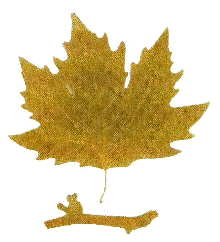
Leaf and fragment of wood
The transcription of excerpts from the letter that accompanied this gift, and from the one with which I replied straightaway, completes the message I wish to convey to the young people who are about to become physicians and to those beginning their activities who will practice the profession in this new millennium, when great transformations are expected, testing their ethical principles at every moment. They must be firm and full of good sense so as not to hinder progress, but also not to let it fall into temptation.
Let us turn to the transcription of the letters, then to the icons celebrated here, and finally to the last paragraph of the Hippocratic Oath, so that the reader may recall the destiny the physician wishes upon himself, whether he remains faithful to his vow or departs from it.
Bebedouro, 12/18/200.
“Dear Irany
I am sending you a leaf from the Plane Tree of Hippocrates and a fragment of the wood, gathered by me, “in loco,” with my own hands. The famous tree stands on the Island of Cos (Kos), on the eastern shore of the Aegean Sea. Visiting it was the very reason for my journey. From there I brought back a seedling (with all the difficulties of customs) and a decree from the Municipality of Cos, offering it to be planted in the gardens of the Faculty of Medicine of the University of São Paulo. It matured and acclimatized, having been solemnly planted in 1997 (three years later). There it stands, robust, to be visited by former students. The leaf and the wood I am sending you (I believe you appreciate these things) may be set in transparent acrylic. I take the occasion to wish you and your family a good Christmas, joy, health, and happiness in 2002.”
Petrônio Stamato Reiff
São Paulo, Christmas 2001.
“My dear Petrônio.
How wonderful! I very much liked the gift. It has already become a heirloom of the family, which has three physicians, two medical students, and the youngest sitting the entrance exam, also for medicine.
I will place the plane-tree leaf and the fragment of wood in a frame together with excerpts from your letter as proof of the piece’s authenticity. In this way, I guarantee, for two more generations, your name alongside this precious document of the history of medicine. An embrace from this friend of yours.
Irany Novah Moraes.
To enhance this document, to recall my youth, and to honor the artist Augusto Esteves, with whom I studied drawing for two years and witnessed the beauty of the trilogy — Hippocrates, the oath, and the Plane Tree — I reproduce the latter here, to form part of the iconography of this piece.
I ask the reader:
Should not someone who learns life on the cadaver, is educated in suffering, shaped in pain, and molded in death, promising devotion to his neighbor and asking for himself the gravest of penalties should he fail to follow his oath to the letter — should not such a person have something in his personality different from that of ordinary people?
See the ending of the Hippocratic Oath and do not answer; make your own reflections: “If I keep this oath faithfully, may I enjoy my life and my art with good reputation among men and forever; if I depart from it or violate it, may the reverse befall me.”