André Krell
Reproduced, with the author’s permission, from http://members.tripod.com/alkimia/
The evolution of Organic Chemistry gave rise to many important industries. One example is the explosives industry. An explosive is any substance capable of decomposing rapidly, with a sudden expansion of gases and a great release of energy. From a chemical standpoint, it is interesting to note that the great majority of modern explosives are organic substances containing the element nitrogen.
In the 9th century, the Chinese invented gunpowder, a mixture of roughly 65% saltpeter (NaNO3), 20% charcoal, and 15% sulfur, by mass. Initially, they used it only to produce fireworks.
It was probably the German Berthold Schwartz (1310-1384) who invented the cannon, bringing gunpowder into military operations.
Despite various improvements, such as the replacement of powdered gunpowder (a very fine powder) by granulated gunpowder in 1425, it may be said that gunpowder was the only efficient explosive available to Humanity for several centuries.
The modern era of explosives began in 1838, when the French chemist Théophile Jules Pelouze (1807-1867) succeeded in preparing nitrocellulose. In 1846, the German chemist Christian Schönbein found that nitrated cellulose is highly explosive. Cellulose is a natural polymer whose structure is the repetition of the unit C6H10O5; in each of these units there are three hydroxyl groups that can be esterified. Nitric acid can esterify one, two, or three of the hydroxyls, producing various types of nitrocellulose, whose flammable and explosive character increases with the nitrogen content of the molecule.
In 1847, the Italian chemist Ascanio Sobrero (1812-1888) prepared nitroglycerin from glycerin, an abundant by-product of soap manufacture. He then found that nitroglycerin is a liquid that explodes with extreme ease upon heating or by a simple mechanical shock. The application of this explosive was delayed for several years because of violent explosions that killed and injured those who tried to manufacture, store, and use nitroglycerin.
Finally, in 1867, the Swedish chemist Alfred Bernhard Nobel achieved a safe way to use nitroglycerin by inventing dynamite, a mixture of 75% nitroglycerin and 25% diatomaceous earth (diatomaceous earth, infusorial earth, or kieselguhr is a powder derived from single-celled algae with siliceous walls). On that occasion, Nobel also invented the mercury fulminate detonator, Hg(ONC)2, to trigger the explosion of dynamite. With these innovations, nitroglycerin production rose from 11 tons in 1867 to 1,350 tons in 1872.
Alfred Bernhard Nobel was born in Stockholm (Sweden) in 1833 and died in San Remo (Italy) in 1896. His father was an engineer and inventor who devoted himself to the manufacture of explosives. As a result of several explosions, Nobel’s father lost some assistants, his own youngest son, and his fortune. Persecuted in his own country, he fled with his family to Russia. There he regained his fortune by producing explosives for the Crimean War and by exploiting oil in the Caucasus. As a result, Alfred Nobel’s son was able to study in Russia and later in the United States and France, specializing in explosives.
After the invention of dynamite in 1867, Nobel invented gelatinous dynamite, or blasting gelatin, in 1875, a mixture of nitroglycerin, nitrocellulose, solvents, and petroleum jelly. At the time, the consumption of explosives increased greatly owing to the growing construction of tunnels, railways, and the like. With his explosives factories, the income from his patents, and his oil operations in Russia, Nobel amassed an enormous fortune. Late in life, saddened by the growing military use of the explosives he had created, he left his entire fortune in his will to the Nobel Foundation, thereby instituting the Nobel Prize. This prize has been awarded annually since 1901 to those who “confer the greatest benefit on Humanity in the fields of Physics, Chemistry, Medicine, Literature, and World Peace” (in 1969, the Nobel Prize in Economics was added).
Late in life, suffering from angina and several heart attacks, Nobel was treated (an irony of fate) with nitroglycerin, which is still used today as a coronary vasodilator.
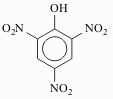
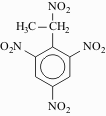
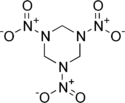
In the early 20th century, largely as a result of the First World War, new and more powerful explosives were invented, such as TNT, tetryl, and RDX:
|
|
|
|
|
Trinitrotoluene (TNT) |
N-methyl-2,4,6-trinitro-phenyl- nitramine (tetryl) |
Cyclotrimethylene- trinitramine (RDX) |
Unfortunately, explosives are used in all kinds of civilian and military weapons. Their peaceful use, however, is very extensive: in quarries, in the cutting of canals, in the construction of roads and railways, in the deepening of harbors, in seismic prospecting, and so on.
In pyrotechnics, there are fireworks and signal flares, used in searches at sea or on land. The production of these fires always involves mixtures of oxidizers (nitrates, chlorates, perchlorates, peroxides, etc.); organic or inorganic fuels (reducers), such as sulfides, hydrocarbons, carbohydrates, etc.; and substances that produce various colors, such as compounds of copper (blue), strontium (red), and so on.
In Brazil, the largest quantity of explosives is produced by the Army. The manufacture or importation of explosives by private parties is permitted only with the authorization of the Ministry of the Army.