The Birth of Health Plans
(An Evolutionary Historical Study)
Irany Novah Moraes
Disease and pain have been, through the centuries, inseparable companions of the human being. For this reason, health is regarded as life’s supreme good. The original teachings on the art of healing are attributed to gods, and those who cultivated the health sciences have always held, among all peoples, a place of honor. Concern with collective health, however, is a much more recent matter. When the average human lifespan increased, it came to be understood that, if greater attention were given to sanitary problems, great benefits would accrue to society.
The idea that the State should provide assistance to every citizen should be attributed to WILLIAM I (1797-1888), King of Prussia, and was put into practice by BISMARCK (1815-1898), his prime minister, the creator of the “Funds” for assisting the sick, the injured, and the elderly. Bismarck’s idea seems to have been the key to discovering the possibility of mitigating catastrophe through foresight. The social significance of this fact was such that it went beyond the very purposes of its original aims, creating the conditions for analogous initiatives, though distinct in their goals and structure.
After the industrial boom of the late nineteenth century, it was observed that disease represented the elimination or reduction of productivity in industry. From the individual standpoint, it also always meant a drop in income, paradoxically alongside the demand for greater financial resources arising from the increased expense imposed by the treatment of the illness in question. For hundreds of years this situation cast disease as an unforeseeable financial disaster — a veritable sword of Damocles hanging over the heads of those responsible for the family’s economy or even for their own subsistence.
The evolution of these ideas was slow to take shape. Although LASALLE, in 1863, had conceived of individual care through collective means obtained by foresight, it was only in 1919, at last, that the notion of Social Insurance took hold, after the signing of the Treaty of Versailles.
“Insurance” seeks to reduce or eliminate the harm of a risk measurable in economic and financial terms. Now, since disease results in loss of productivity and represents a decrease in earnings, health insurance seemed logical and perfectly acceptable. Curiously, however, this notion failed to captivate communities, especially individuals of small income. This was probably due to the short-sighted reasoning that the reimbursement of lost income in the event of illness would in any case be insufficient to cover the expenses, whereas the payment of the insurance premiums represented an immediate reduction of income at a time when it was already low.
In the century before last and in the first two or three decades of the last one, insurance was of interest only to employers who, by insuring their employees, protected themselves against the losses resulting from the workers’ forced immobilization due to illness. The individual and their dependents, however, remained outside the reach of welfare measures.
On the international level, concern with health is so great that in 1962 the WHO — World Health Organization — devoted to its medical research program a credit of one million dollars, and the United States government made an equivalent contribution. From these figures one can sense the attention that came to be given to health.
In the United States, in 1929, KIMBALL observed that hospital expenses were beyond the means of the secondary-school teachers at the school where their children studied, which made it difficult for them to obtain care when hospitalization was required. It was then that he conceived a system of “prepayment” for the eventual expenses of illness. This process differed from ordinary “insurance,” for instead of offering monetary indemnity to compensate for the losses arising from illness, it offered care for the cure of the disease. Thus the American “Blue Cross” was created on 12/20/1929. The system was simple: the individual enrolled in “Blue Cross” paid a fee corresponding to their monthly income, securing 21 days of hospitalization. If they paid for 344 days without drawing benefits, the remaining days were paid at a discount. The plan’s success was so great that merchants too began to enroll in “Blue Cross,” under whose aegis the Associated Hospitals was formed. During the crisis of 1930, the benefits the plan provided to the community were immense, and in 1933 the American Hospital Association accepted the system.
Ten years later, that is, in 1939, another initiative of the same kind took place in the United States: “Blue Shield,” an organization created by the California Medical Association, which, offering medical-surgical services, completed the full range of assistance, since the first provided only hospital care. Later, “Blue Cross” and “Blue Shield” drew closer together and today have common management. In 1962, about a quarter of the American population was enrolled in these organizations, with unquestionable advantages for the individual’s economy.
Nor was it only in the United States that such a system succeeded. In England, in 1944, the solving of this problem began as a State initiative. CHURCHILL created, in 1949-1950, the “National Health Service,” in which 500 million pounds sterling were invested and to which 95% of the population enrolled. All the medical services of Great Britain had been nationalized in 1946. By 1950, 3,426 hospitals had passed to the “Insurance,” with only 147 remaining “free.” In 1960, an assessment of the system’s results disappointed the pessimistic expectations of those who had prophesied negative outcomes. In fact, over those ten years the cost rose only insignificantly; hospital equipment was greatly improved and modernized; and the level of the medical profession held its own or rose even higher.
In Brazil, the situation was curious. Established more than seventy years ago, the “Social Security Institutes” failed to achieve their aims; many contributors were left helpless, and insecurity took root in the popular spirit. It is a well-known fact that, even in the south, where the Institutes were in better condition to serve the contributor, in the moment of need the shortcomings in care were, and are, great. Technological and pharmacological progress advanced greatly. Medicine became far more expensive, aggravating the situation.
With the low average individual income, the problem took on proportions of the utmost gravity. Strictly speaking, only a very small portion of the population is in a position to bear the burden of illness. The country’s industrial boom, beginning in the middle of the last century, with the establishment of the automobile industry and its subsidiaries, of steelmaking, and of development in the electric-power sector, aggravated events in the social-assistance sector.
*
School of Public Health, USP
The School of Public Health of USP has maintained a Course in Hospital Administration since the middle of the last century. The first professor was Odair Pacheco Pedroso, who was assisted by Prof. Dr. Lourdes de Freitas Carvalho, who succeeded him in the chair.
This is where we come in.
NICOLINO BARBÉRIO and IRANY NOVAH MORAES. In this course, in 1960, in the Brasília Class, after an examination of credentials and an interview, we were approved and enrolled.
Course in Hospital Administration
The person responsible for this course, Prof. Dr. Odair Pacheco Pedroso, was a special man, a follower of a Stoic philosophy (Retreat into one’s own soul, live in a perennial exercise of self-reflection to correct error and refine the spirit / Marcus Aurelius, 3rd century AD). Daily contact with him, throughout the entire course, was in itself a magnificent lesson in life.
He maintained a strong bond with the Kellogg Foundation, which sent highly specialized visiting professors to deliver duly planned and programmed blocks of classes. Thus, for months we had classes on Blue Cross and Blue Shield. I remember perfectly that many times during the classes, with each new idea presented, I would alert Nicolino, who sat beside me, saying “this is the solution for Brazil!” At the end of each class I would request the bibliography used by the professor, who always already had a copy of the articles and would offer it to me.
During the school term, the holidays were used, on the longer side of the week, for visits to hospitals in the interior of the state or in neighboring cities, where we went in vehicles donated by Kellogg. At each Hospital or Health Unit we did what was called “documenting.” Following a printed guide, we made precise and complete notes on defined sectors, e.g., the Surgical Center, ICU, Clinical Laboratory, Nursing Unit, and Medical Records and Statistics Service. This procedure, repeated many times, gave the student, at a mere glance, a precise view of whether that unit met the required legal provisions.
The course ended in 1961 with a hospital internship at the Hospital das Clínicas. The two of us, Nicolino and I, had a reduced internship because we worked at that hospital and knew it very well.
**
There were six of us
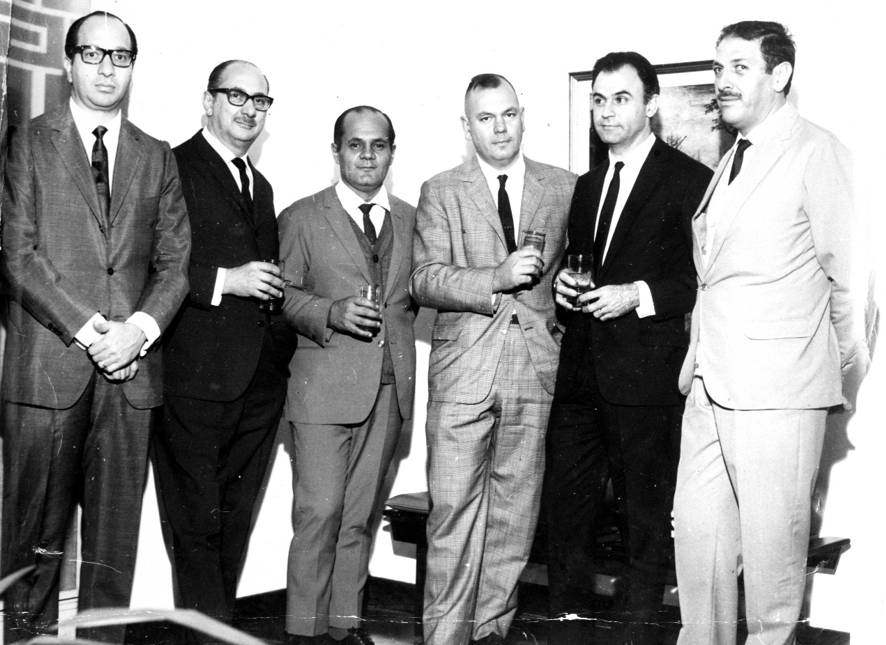
From left to right:
Pedro Nahas,
Nicolino Barbério,
Rubens Monteiro de Arruda,
Irany Novah Moraes,
Joamel Bruno de Mello,
Nelson Abrão
Nicolino Barbério
Administrative Director of the Hospital das Clínicas of the School of Medicine of the University of São Paulo, he was privileged: at USP he worked at the School of Pharmacy and Dentistry with Paulo Artigas, Paulino Guimarães, and Maria Aparecida Pourchet Campos, at the School of Philosophy with André Draifus, and at the Hospital das Clínicas with Odair Pacheco Pedroso. A public-spirited man, he was a councilman in the São Paulo City Council. A compulsive reader. Extremely communicative!
Rubens Monteiro de Arruda
From medical school onward I went to work at the Clinic of Prof. Alípio Corrêa Netto (1st Surgical Clinic) in the Group of Prof. Euriclides de Jesus Zerbini, and the one who introduced me to Zerbini was Rubens, my great friend, who was writing a thesis on the Lung in Anatomy, for which I did the iconography.
Rubens followed, and grew enthusiastic about, the ideas I laid out to him that I had learned in the course. A dreamer, of a mind open to new things and of solid humanistic culture and profound medical knowledge, an excellent thoracic surgeon, having operated a great deal at the Jaçanã Hospital and having done much experimental surgery there and in the Surgical Technique department of the School of Medicine. A doer, he conceived and founded the School of Medicine of Santo Amaro, today part of the University of Santo Amaro – UNISA.
Irany Novah Moraes
At the time I was already a doctor of medicine, having written my thesis under the guidance of Prof. Renato Locchi, with whom I worked full-time. During my shifts as a state forensic physician at the Emergency Room of the Hospital das Clínicas, very enthusiastic about what I was learning in the course at the School of Public Health, I made use of the breaks in the work and, in the physicians’ room of the ER, spoke about the subject. Many colleagues showed interest, and our conversations were long and fruitful. One night, however, one of the most enthusiastic, the Obstetrics Assistant Nelson Abrão, asked whether I had ever thought of implementing this system among us. The answer was, immediately, — of course, I am doing this proselytizing to find someone who wants to enter into this venture. Enthusiastic, he took up the challenge. I then recommended that he seek out Rubens and Nicolino and express his wish to take part. He was the fourth of the team taking shape.
I record here an unusual fact. I was invited by Prof. Reale to organize and direct the Health Service of the ISSU, which, in the University Reform, came to be called COSEAS. On that occasion the Amesp was already a reality; it was ten years old. I had the opportunity to repay, in practice, at the Medical Directorate of COSEAS, to the University, what I had learned in theory in Prof. Odair’s course.
Nelson Abrão
An Obstetrics Assistant, he took shifts for that clinic at the Emergency Room of the Hospital das Clínicas. With vast experience in the specialty, well regarded and hardworking, he agreed to take part in this venture.
At the first meeting of these four, Nelson suggested the name of Pedro Nahas, who, he said, was a very good friend of his and whom he would like to have in the group, and who wished to bring in Joamel Bruno de Mello.
Pedro Nahas
He was at the time already a notable specialist in proctology, of a high technical level but marked by a trait that indelibly distinguishes the surgeon: devotion to the patient. Devotion accompanied by competence always yields an excellent result. He too later completed his doctorate in Anatomy.
Joamel Bruno de Mello
Joamel always distinguished himself by his intelligence. In the surgical act, his elegance in operating was always his strongest mark. His doctorate, too, was completed in Anatomy with brilliance, and his Livre-Docência was passed with distinction in all five examinations.
***
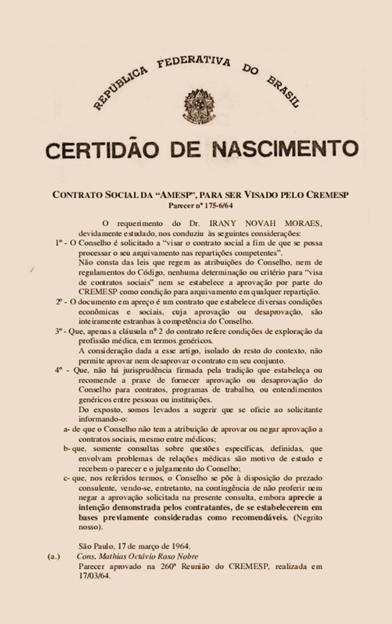
Thus Amesp was born, whose birth certificate is, in this article, the opinion of the Regional Council of Medicine – CREMESP, which cleared us to practice this modern form of medical assistance.
****