Crisis is, for the physician, a sudden change in a patient’s state of health. It arises from the unstable balance of the struggle between the aggressing agent and the existing defense forces mobilized by the organism. The clinical manifestation is abrupt and marks the critical moment for the patient, for it may evolve toward rapid cure or toward collapse. Such a picture can be generalized, considering it not only for the human organism but also for the social or even societal body.
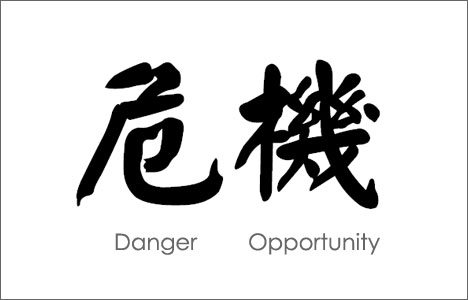
The Chinese ideogram used to convey the idea of crisis is composed of two parts. The one at the top of the figure means danger and serves as a warning, for it reveals imminent risk; the one at the base means opportunity, signifying the possibility of solution, of improvement, of refinement, and of purification. The whole carries a great lesson within it: although a crisis wears down and brings the risk of shaking an entity, possibly annihilating it, on the other hand, once overcome, it also opens the way to improvement, even to evolution and progress. Clearly, to seize the opportunity, one uses intelligence, good sense, effort, and the dedication of those who are competent and sincerely interested in solving the problem and who, fundamentally, possess an elevated public spirit.
A brief digression allows us to recall that, in our language, words of opposite meaning can form equivalent expressions, sometimes even with a certain nuance of emphasis. An example occurs on one of our beaches, where a fenced “power station” has two gates with warning signs: on one side is written “danger to life” and on the other “danger of death.” Life and death, antagonistic words, in this case with the same meaning, prompt reflective thought for their understanding. That is what is sorely lacking.
The present moment is a special one, for it mobilizes those concerned, who must assume their share of responsibility. Such a widespread sentiment, which one might call collective conscience, makes the moment ripe for reflection. I recall Paulo Duarte, the journalist who, alongside Julio de Mesquita Filho, helped Armando de Salles Oliveira found the University of Sao Paulo, and who recounted a dialogue he had had with Paul Rivet, Director of the Museum of Man in Paris, along these lines: “if a Martian could observe the Earth at the moment reflection arose, he would not marvel at the light of cataclysms, nor at the atomic bomb, but he would be dazzled by the light of reflection.”
Counting on that energy, a ray of illumination from the intelligence of public men and, above all, on moral force—which, incidentally, is thinning out alarmingly under this government—it is time to set aside shady personal and material interests in order to solve the chaos in which the country’s civil aviation finds itself.
Sao Paulo today is an anarchic air base. Passenger and cargo planes, as well as helicopters, pass all over the city, every day and all day long! They do not even respect the official routes. “Information” is a word whose meaning is shifting toward “deception,” for the authorities are not ashamed to say that “tomorrow” everything will be sorted out. That tomorrow never comes; they seem to waver between the danger to life and the danger of death. Will it take a catastrophe to hold so much incompetence accountable?
* Dr. Irany Novah Moraes was a professor at the USP Faculty of Medicine; he is a physician and author of Erro Medico e a Justica, RT, 5th edition, 2003; and Tratado de Clinica Cirurgica, 2 vols., 2300 pp., Ed. Roca, 2005.