PROF. DR. IRANY NOVAH MORAES
To see and not perceive is common;
to see and perceive is a skill;
to perceive what one sees is intelligence,
but to perceive what one does not see is a privilege.
Every teacher carries within an abiding concern for teaching. And so they seek the most varied ways to attain their goal, whether by awakening interest or by stirring the motivation to open young minds. The Law of Guidelines and Bases of National Education regulates what must be taught, but not how it should be taught. It is precisely here that the difference between teachers lies. Only those who care about how it should be done distinguish themselves to the point of founding a “school.” They are virtuous; they devise methods to educate their students, knowing that these students will need many skills to acquire the competence to develop in the profession. In this difference of preparation lies the superior role of the university: to open the mind! With an open mind, the individual more easily acquires the capacity to adapt and thus to follow Darwin’s precept: “it is not the strongest that prevails, but the most adaptable!”
The academic community, whether teaching or learning, must be imbued with the relevance of its role in society. To give substance to this message, I will offer examples from anatomy, where the student first comes into contact with their future profession and which, for them, usually marks the beginning of the fulfillment of a dream. It is common for the student to think, mistakenly, that they are being taught something unimportant, and thus to criticize anatomy as an essentially rote subject and, for that reason, of lesser importance.
A brief digression is in order here to comment on the modern expression “by heart,” and, to emphasize it, the phrase “off pat,” meaning well memorized, which derives from the fact that the ancient Romans believed memory resided in the heart. Those who think this way fail to realize that everything one knows is memorized. One’s very name is, too. Thus there is nothing wrong with memorizing. However, many of those who fixate on this primary criticism have not realized that, well beyond that teaching, anatomy develops other qualities in the student. Certain demands in its teaching reveal a degree of high training of the intellect. Everyone knows that the aim of higher education is to enable the individual and make them capable of solving the problems they will encounter throughout life — problems even unimaginable today!
Many examples could be presented to demonstrate such teachings; however, I will confine myself to a few so that the reader, starting from them, may reflect and find others from their own experience, moments in which they did not realize at the time that they were learning, without noticing, something more that was literally not on the syllabus.
Five examples are presented below:
1 – General Plan of Construction of the Human Body
This plan follows five principles, namely: a) bilateral symmetry; b) metamerism; c) tubular formation; d) stratification; e) variation within normality.
- Bilateral symmetry – The median sagittal plane divides the body into two roughly symmetrical halves, called antimeres. Such symmetry is more apparent on the exterior than in the interior of the body.
- Metamerism – The superimposition of morphologically similar elements is clearly visualized in the vertebral column.
- Tubular formation – from the vertebral column, from which extensions arise toward the back and toward the front, forming, respectively, the neural tube and the ventral, or visceral, tube. These two tubes lie one before the other, constituting the so-called visceral and neural pachymeres, respectively. Both are enveloped by the tegumentary tube.
- Stratification – The various layers, starting from the bone, are: I – muscle; II – aponeurosis; III – the subcutaneous tissue described by STERZI (1912), which lies between the skin and the “muscular fascia,” composed of the deep limiting layer and the superficial “areolar” layer, both separated by the fascia superficialis.
- Variation within normality – Within normality, one may also consider the great principle of variation.
In learning the GENERAL PLAN OF CONSTRUCTION OF THE HUMAN BODY, following all its principles, the student learns, often even unconsciously, that nature did not program organ by organ, nor even system by system, much less apparatus by apparatus, but formed an extremely interwoven whole to be seen by the physician when examining it globally and not merely by organ, system, apparatus, or tissue.
Having this holistic view, the student will, without much effort, ipso facto remember that this individual has a family, belongs to a community, and is always part of a larger universe.
2 – Reliefs of the Base of the Skull
When studying the reliefs of the base of the skull, such as the projections and the foramina, whether from within or from the inferior surface, identifying which arteries, veins, or nerves pass through, where they come from and where they go, one not only learns the fact itself but also becomes mentally aware of the three-dimensionality of the structures of the human body.
Through this intellectual exercise, one learns what must be done to identify the minute detail within the larger context; one fixes the three-dimensional idea of the human being who integrates sensory stimuli departing from one extremity, processing the message in the nervous system, and even issuing the command for execution at a distance and, if it is important or necessary, recording that data in memory!
Recently I witnessed a neurosurgeon, Marcelo Campos Moraes Amato (August/2006), wishing to imagine how to reach certain structures, seeking to obtain a skull and a brain in order to mentally picture those structures in space along the three axes: median sagittal, transverse, and craniopodalic.
3 – Vertebral Theory of the Skull
Along this same line of thought and with the same objective — to understand the similarities within the differences — I felt the need to delve deeper into the subject, a fact that makes it fitting to treat this theory.
It may be said that, at a very primitive phase of the embryo, there is an analogy — that is, an equivalence of form — between the bones of the vertebral column and those that constitute, in the adult, the cephalic skeleton. Such modifications, observed in this segment of the vertebral column, relate directly to the evolution and growth of its contents. Thus, the brain conditions the skeleton that contains it, to a development suitable for enveloping it.
In humans, as well as in some higher animals that also have a developed nervous system, the dorsal arches of the primitive vertebrae move apart to form the neural cavity. To complete the opening thus established, bones of membranous origin arise. This does not occur in lower animals with small brains.
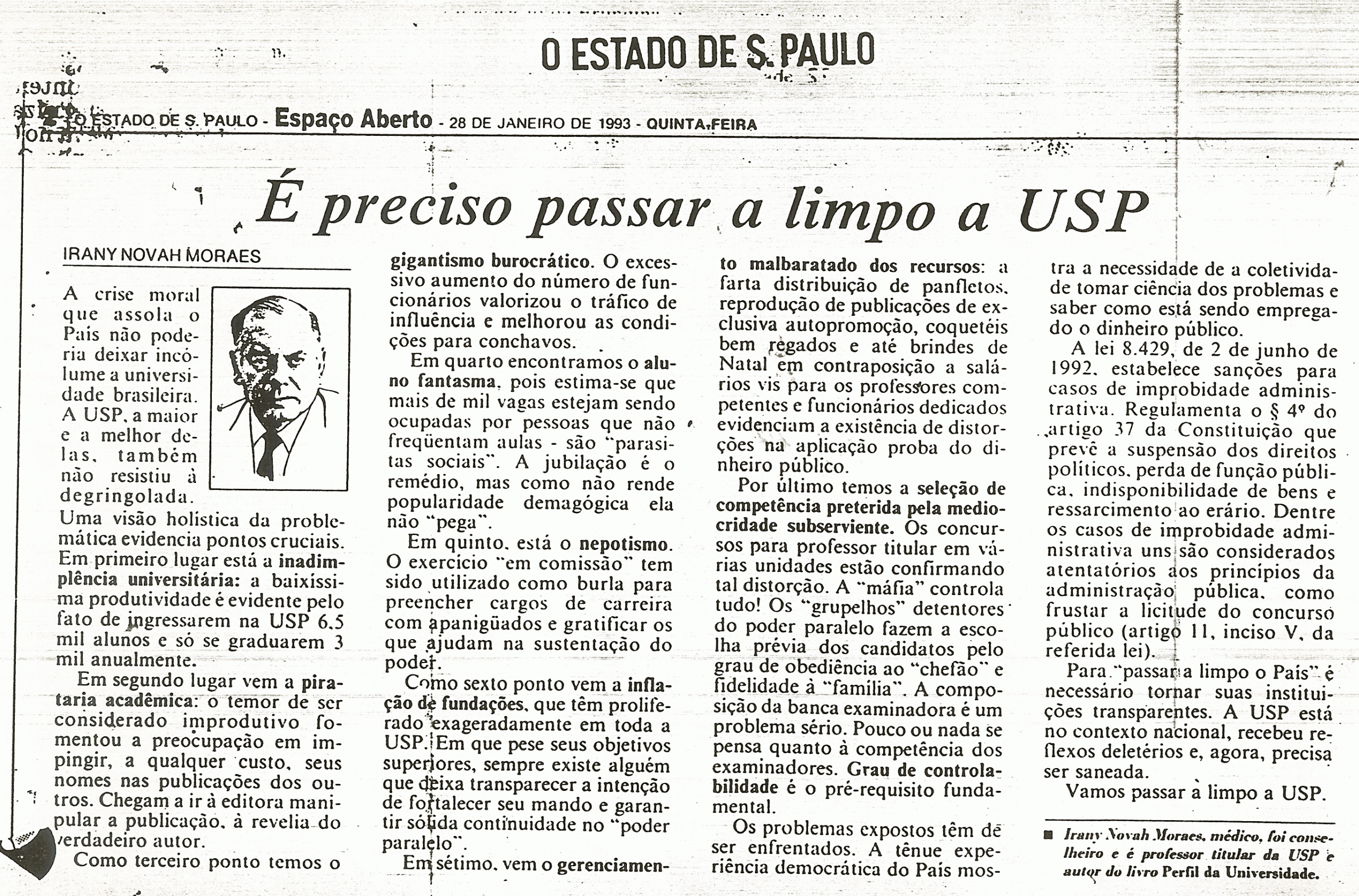
Goethe, in 1790, developed the so-called vertebral theory of the skull. He confided it, in private letters, to Oken, who kept them for twenty years, later publishing them as his own ideas. (See how human beings have always been the same, in the article I published in O Estado de S. Paulo, January 28, 1993 – É preciso passar a limpo a USP). This theory was framed around the idea that the skull is composed of as many modified vertebrae as it has pieces. Certain particularities, as occur in the occipital bone, readily lead one to understand its analogy with a vertebra — that is, the occipital has a function equivalent to that of a vertebra. The base of this bone resembles in every respect a true vertebra – it is a modified vertebra.
The notochord of the embryo corresponds to the primitive column; its marks lie in the vertebral bodies, and its embryonic remnants, persisting in the adult, correspond to the nucleus pulposus of the intervertebral discs. Although there may be an imaginary line of analogy along the entire vertebral column up to the dorsum of the sella turcica, in the sphenoid, from there upward the bones of the skull are no longer homologous to the vertebrae, and the resemblance fades. The skeleton ceases to be metameric, but remains segmented. The study of the embryo offers elements that allow one to establish the boundary between the metameric and the segmented parts.
If, on the one hand, an ontogenetic review permits this reasoning, phylogeny, too, provides other elements suggestive of its truth.
Thus, comparative anatomy shows, in higher animals, on account of their greater relational life, greater development of the bony skeleton around the central nervous system, to the detriment of the dimensions of the facial skeleton. This view is more evident when the bones of the human head are compared with those of certain monkeys.
The skull in humans possesses a metameric portion secondarily acquired. In theory, the embryo evolves as follows: the primitive skull, being insufficient to contain the brain, so developed in humans, needed to encompass certain neighboring bones in order to expand. The vertebrae of the upper portion of the column were thus incorporated. The skull then acquired a portion derived from the modified vertebrae situated above the atlas vertebra. The cranial vault is closed by another contingent of newly formed bones.
In lower animals, the neurocranium is reduced to the paleocranium, whereas in humans, in addition to this, there is also the neocranium. The contingent belonging to the paleocranium is essentially segmented and satisfies the vertebral theory of the skull, whereas the neocranium has one portion of vertebral origin, secondarily acquired — the occipital — and another, non-vertebral portion — the cranial vault — of dermal origin.
The occipital bone is composed of at least two vertebral pieces. The cranial vault has a secondarily formed portion. The primitive neurocranium is, at first, of exclusively cartilaginous origin, being formed by the vertebral column modified in its upper part, which persists in this state in lower animals, where the chondrocranium suffices to contain the brain. In more evolved animals, which exhibit an enlargement of the brain, bones of membranous origin appear, constituting the desmocranium, in almost its entirety, the cranial cap.
Knowledge of this theory demands deep reflection to perceive, in this phylogenetic evolution of the vertebral casing, the construction of the protective structure of the nervous system, and thus to grasp how wise nature is.
4 – Identification of the Teeth
It was always a Boverian practice, followed by Renato Locchi, the exercise of tactile memorization for studying the teeth, to the point of being able to identify them by palpation without the aid of sight. In a way, perhaps because of its frequent repetition, it recalls the religious habit, far more common among the peoples of the Middle East, of holding a “rosary” and touching each of its beads one by one. In a small cloth bag containing the thirty-two human teeth, one practiced identifying them: incisors, canines, premolars, and molars, knowing whether from the maxilla or the mandible and, further, whether from the right or the left side!
It is an exercise in tactile interpretation, extremely difficult, but which, perhaps because of its playful element, was never tedious and always aroused a certain competition among my classmates to see who guessed correctly most often.
Evidently, looking back on that time, the time spent trained the student to exercise their brain, to learn to feel “seeing by touch,” to memorize in this way, since it truly represented an intellectual exercise.
Such tactile skill undeniably gave anyone who enjoyed this exercise excellent discernment for palpating and feeling extremely faint pulses, resulting from stenoses upstream, with arrhythmias, and for perceiving thrills. Just to illustrate this skill, I recall that PROF. ALÍPIO CORRÊA NETTO used to tell of a colleague of his time who received a scholarship to study internal medicine in Germany. He returned with much knowledge but also with a special ability to delimit the thoracic projection of the cardiac area by superficial palpation, sliding the four fingers of the hand over the precordium.
What is the demerit in also acquiring this skill? Evidently, in the modern world with so many non-invasive tests providing so much information, it does not withstand the central question of the Roman legislator who asks “cui bono?” (whom does it serve? whom does it benefit?)
5 – Major Sensory and Motor Pathways
The final study of neuroanatomy, linking, in a global way, all the learned structures of the nervous system, gives the student a complete integration, thus understanding the pathways through which the conscious and unconscious impulses that sustain our animal life travel.
It allows one to understand where, within the complex architecture of the nervous system, a small lesion can sever a life, keeping the patient in a vegetative state and from there to death — whether or not passing through the multiple stages resulting from lesions at the various points of the nervous system.
It is hard to accept the behavior of one who learned this fascinating integration and who, once a physician, does not examine the patient correctly and sees only the site of the pain, without considering the patient as a whole.
This fact makes the difference between the physician who examines the patient and the one who merely prescribes with an eye only to the complaint.
6 – Managing Emotion
Since one does not know how to teach good sense, still less can one imagine how to teach the managing of emotions. Emotion is the systemic response to a stimulus captured by any of the sense organs. The stimulus of sight, hearing, smell, taste, touch, heat, or cold, depending on its nature and intensity, once processed in the thalamus, instantaneously triggers a stimulus along the sympathetic pathway that, in the medulla of the adrenal gland, releases adrenaline into the blood and thus establishes the alarm reaction! How can one teach someone to control their responses? It is truly very difficult; however, in the medical course, everything begins in the first class, and for six years, every day, suffering, pain, and death are present. The physician does not become insensitive, but learns to live within this context and thus to build up the strength to serve as support for the patient and their family.
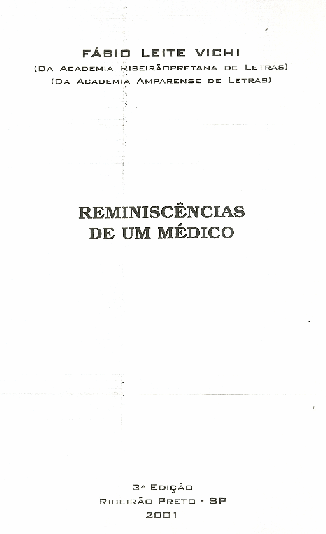
I will reproduce two classic introductory anatomy lectures for the medical course. These are the inaugural lectures on the São Paulo campus, by Prof. Renato Locchi, and on the Ribeirão Preto campus of the University of São Paulo, delivered by Prof. GERSON NOVAH, the latter recovered by FÁBIO LEITE VICHI, in Reminiscências de um médico, 3rd ed., Ribeirão Preto, SP, pp. 91 to 93, 2001.
PROF. RENATO LOCCHI
The inaugural lecture given by Renato Locchi, which I attended, warned of the intensive and proper use of time, which passed all too quickly to allow one to know the entire human body sufficiently to be a physician. He called attention to the fact that we were going to study on the cadaver and that it deserved the most absolute respect. In the course of the lecture, with a broad, firm, continuous gesture, he removes the white sheet, uncovers the table, and, on the marble, lay the cadaver of a young Black woman. The very same with which Alfonso Bovero had given his inaugural lecture some decades earlier.
The impact triggered by the abrupt exposure of the cadaver profoundly impressed the young student; his mind entered into conflict as it tried, in a flash, to grasp the time of life and the time of death. The 28-year-old woman, with a delicate face, a sad, placid countenance, fixed in formaldehyde for longer than she had been alive, lay permanently unchanging.
Locchi, with erudite speech, of vibrant timbre, incisive and lively gesture, etched this moment into the student’s memory. The young man had the sensation of entering a mystical world, where death was present to teach the secrets of life. He learned to respect the mortal remains, fragmented by dissection, as being part of the body of his fellow human being. The cruelty of life became evident, which by chance had placed her in the condition of a “specimen” for study. There lingered, too, the impression of destiny exacting, after death, the burden that perhaps, in life, she had caused society, of which she was a victim. Those circumstances marked, for the future physician, his beginning in the ceaseless struggle against death. The moment was conducted thanks to the dazzling personality of Renato Locchi, and two enormous forces were in conflict: the vigorous energy of the youth present, attentive and perplexed on one side, and the coldness of death on the other. The student felt as if he were taking part in the ritual of his initiation into the priesthood of medicine.
After the inaugural lecture, a visit to the Laboratory took place: – 1. Bovero’s Room – The room of Professor Alfonso Bovero was kept as he had left it. There were: his long apron, yellowed by time; the pointer and the work table. The visit to this place was made with respect and in absolute silence. It gave the impression of being at the altar of a cathedral. – 2. Bust of Bovero – The memory of Bovero, kept permanently by his stern-eyed bust, strategically located in the foyer of the Laboratory, ensured the sense of his omnipresence in that setting. – 3. Library – The Anatomy library was on the students’ visit itinerary. Locchi displayed the collection with the pride of showing the most valuable monument of devotion to its founder. First, he presented the collection of rare books. He then showed the collection of indexes and catalogs used for bibliographic research in the field of Anatomy. He boasted that the collections of journals were complete and without a single gap. Next he pointed out the shelf of classic treatises. Extreme satisfaction became evident when he entered a recess of the Library where, in tall shelves and on properly classified racks, stood boxes containing the richest collection of research offprints. Bovero had meticulously begun this collection of documents, and Locchi had been continually contributing to keeping it up to date. – 4. Museum of Specimens – The next station on the Anatomical Way was the Museum of Specimens, carefully begun by Bovero and with the participation of all the anatomists who worked in that laboratory. A museum extraordinarily rich in specimens of the most varied preparations. Each of the many cleared and transparent specimens represents hundreds of hours of work. The collection of specimens of the lymphatic system is precious; there are also many preserved by other methods. The collection includes fifteen hundred specimens, consisting of tongues and larynges, meticulously catalogued by ethnic group, sex, and age by Prof. Bovero himself. A collection of plaster masks of Brazilian Indians is part of the Museum’s holdings. – 5. Museum of Bones – The other stop occurred at the Museum of Bones, where more than a hundred complete skeletons are catalogued and kept in suitable drawers. Two comments were made: one showing the skull of an adult Black male, in which the dental arches were complete and intact, and another, in a display case acquired in Germany, with the reproduction of a fetal skeleton with all its bones, including the ossicles of the middle ear, and then he would show another similar one, made by a laboratory employee who, though having no training whatsoever, had great skill, much dedication, and love for what he did.
The University Reform, which moved the basic courses to the Institutes, transferred part of this historical heritage of the University of São Paulo Medical School to the University City Campus, at the Institute of Biomedical Sciences.
PROF. GERSON NOVAH
“My students:
On entering this Faculty, you underwent an austere, competent, and rigorous examination; its result is eloquently expressed in your present presence in this hall; in these happy expressions of victory and of effort rewarded. You know that victory and effort bring irrefutable rights. I wish to speak to you a little of these rights. The first of them, certainly very great though not the greatest, is that it assures you, in this course, a calmer study, almost carefree, without the dangers of cadaveric infection, without the dangers of contagion, such risks and dangers entirely removed by the advent of the formalization of cadavers.
Some of you, less restrained, quicker to judge and readier to smile, will find this right banal, almost trivial, even insignificant, a veritable counterpoint to the great effort demanded of you. You are not right, if you remember that Anatomy went through dark and difficult days, through a frighteningly tragic past, in an age when public opinion, dominated by a mysticism respectable up to a point but wholly unenlightened, absolutely forbade the study of Anatomy on cadavers.
Whoever practiced it would be subject to the vengeful and primitive fury of a bloodthirsty horde of mystics ready to perpetrate the most primary of justices… or rather the most primary of injustices…
Yet the anatomists of that time, genius-martyrs of knowledge, braving the danger of being considered violators of cadavers, at nightfall, protected by darkness, aided by the wan light of the moon — that eternal accomplice of the heart — these anatomists, I said, joined the vultures of the fields to steal the cadavers of executed criminals which, on shadowy trees, swayed like strange pendulums of the clock of human justice.
The prey stolen, sometimes already putrid, other times still bleeding, the nocturnal usurper, risking all manner of infections, cadaveric infection, and the dangers inherent in the undertaking, without means or preservation, carried out, under the anguishing weight of so many threats, the great discoveries that honor and exalt anatomical science.
Other times matters unfolded differently; the criminals executed, their bodies were to undergo a regular burial. The difficulties were now greater; it was necessary for clandestine vandals to practice, in the cemetery itself, at night, the exhumation of the cadaver; but, the intention being known, riot squads organized themselves, armed and hidden, prowling among the tombs awaiting the exhumers; the encounters were terrible and often fatal.
In that period, a well-known English anatomist was sought out by a man who proposed the sale of the body of an executed criminal who was to be buried that very afternoon, to be stolen at nightfall and delivered, that same night, to that man of science.
Restless, impatient, alone, he watched the hours pass without any news arriving. Night was already giving way to the small hours when, in the heavy silence, an anxious and violent knocking at the door announced the arrival of the messenger; a figure, with manifest effort, with difficulty, carried on its back another, inert, limp, still bleeding. The one who brought the cadaver was not the man who had made the deal; it was a female figure, an image of pain and suffering; of disquiet and despair; of martyrdom.
There had been a struggle; the cadaver could not be stolen; the urgency of sustenance in that woman’s home was great; her husband, the man who had made the deal, had fallen dead in the encounter. She represented her spouse’s last financial contribution; there lay his cadaver to be sold… Tragic stories, and yet simple, isolated, scattered incidents of the great tragedy of Anatomy.
Let us return to your rights. A second right you have known how to win, my students. The right to have duties, and, among the duties, there is one that exceeds all others: respect for the cadaver and for the austerity of the setting. Remember that the physician’s formation and their entire life are molded in death and in pain; beside the cadaver or beside the bed of the sick. As into a cemetery, into a department of Anatomy one enters with heart and soul. Into the former, in despair and pain; into the latter, with respect and gratitude. Remember that here ‘death takes pleasure in aiding the living’; remember that in communion with death we often find a meaning for our own lives.
Do not treat the cadaver as simple, mere study material. Contemplate in the icy, colorless, almost transparent face of the dead, in the serenity of the countenance, what may hide from you the bitterness of the castaway or the agony of a prolonged suffering; contemplate in this flayed body, in these piously abandoned and fallen limbs, someone who perhaps was still alive only yesterday; someone who, like us, had a childhood, a family, affection, a home; someone who was a child and was young; who had sorrows and joys, hopes and disappointments, but who, unlike us, who count on the complicity of a favorable destiny at birth, in growth, in education, and in instruction, had reserved for them, by the strange game of chance, only the place of the marginalized of fortune, of social castaways, of human rags.
Remember that they lacked everything, even the friendly and welcoming gaze which, bitter though it be, might receive, in the anguished and final instant, the last appeal, the last supplication, the last flicker. Remember, too, that however burdensome, useless, harmful, or noxious these remnants of humanity may have been, the service they now render to the common good, to this and to future generations, well redeems their guilt for having been the misfits of their generation.
My students: these counsels are not new, nor are these ideas mine. They are counsels and ideas that speak to the heart and to the never-denied nobility of youth. They are, for that reason, common property, they are universal. Heed them, is my request; heed them, is your imperative. They will not fail to speak to the sensibility of future physicians.
And remember, too — either you already have, at this moment, the sensibility of a physician, or you never will. Today is the true day of your professional decision; if you do not feel yourself worthy of the priestly vocation, for our good, and more than that, for your own good, cross today for the last time the narrow threshold of this door, which represents the threshold of medical initiation, because if you do not worthily wear the garb of the novitiate, you will never worthily wear the sacred mantle of the priesthood.”
The lectures presented make evident the emotional load that the eighteen-year-old receives on the first day of class. He feels the impression of having passed through the mystical ritual of admission into the priestly life of the profession.
In the course of the subsequent years, his contact at each stage of the course is a lesson in managing emotion. Thus: in topographic anatomy, with the whole cadaver, head shaved and preserved in formaldehyde; in pathological anatomy, with a cadaver still with hair and without preservation. On the ward, the patient dying and the family weeping at the bedside. The physician thus lives with pain, suffering, and death. Though he does not grow used to it, since with each episode he too dies a little! And so he restrains himself, and in this private suffering he learns to manage pain and manages to be the support of his patient and of others’ pain. In this exercise he grows and develops the strength to remain steadfast in the profession.
Speaking of the priestly life, it is fitting to recall Alípio Corrêa Netto’s interpretation of the priesthood, affirming that it has nothing to do with the non-remuneration of work but rather with devotion to it.
7 – Final Words to the Young
- If the reader is a young physician who did not feel what they learned in anatomy without realizing it, there is still time: exercise your memory, recover these teachings, and make your reflections.
- If none of this occurred, judge your school. It still owes you this; demand it!
- But if your memory does not fail you and you feel that something more, remember that “one should speak only when the message is better than silence”; promise yourself that when you speak to the young, you will convey positive messages — they do not deserve laments and personal frustrations.
8 – National Reality
- Good schools should be encouraged to become excellent.
- New schools with proven potential to become excellent should be welcomed.
- But bad schools, even if free, should be closed. They are delinquent. They only grant diplomas and form neither physicians nor, much less, citizens.
*