Prof. Dr. Irany Novah Moraes
Renato Locchi was the greatest teacher I ever knew. One of his most beautiful masterful lectures, at the Department of Anatomy of the Faculty of Medicine of the University of São Paulo, was on the vertebral theory of the skull. To reproduce a fragment of it, drawn from the notes I have kept for half a century, is the finest tribute I can pay him, in celebration of his centenary, for he was born on 7 May 1896, in Anhembi, São Paulo.
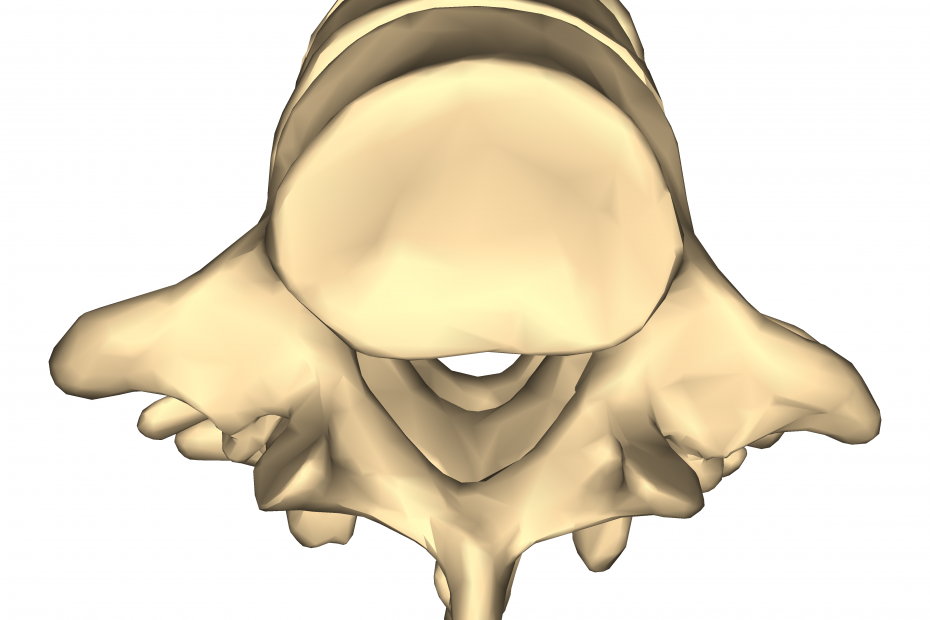
Let us consider the following: a vertebra, viewed in isolation, has a body and two pairs of processes forming arches, one anterior or ventral, the visceral arch, and another posterior or dorsal, the neural arch. The series of vertebral bodies, placed one upon another, forms an axis. The set of visceral arches forms the visceral cavity, while the set of dorsal arches forms the neural cavity. The latter contains the central nervous system, whose development at its upper end will bring about modifications in the skeleton. Embryologically, it may be said that, at a very primitive stage, there is homology, that is, an equivalence of form, between the bones of the vertebral column and those that constitute, in the adult, the cephalic skeleton.
Such modifications, observed in this segment of the vertebral column, relate directly to the evolution and growth of its contents. Thus, the brain conditions the skeleton that contains it toward a development suited to enclosing it.
In man, as in certain higher animals that likewise have a developed nervous system, the dorsal arches of the primitive vertebrae move apart to form the neural cavity. To close the opening thus created, bones of membranous origin arise. This does not occur in lower animals with a small brain.
Goethe, in 1790, formulated the so-called vertebral theory of the skull. He confided it, in private letters, to Oken, who kept them for twenty years before publishing them as his own ideas. This theory was built around the notion that the skull is composed of as many modified vertebrae as it has pieces. Certain features, as in the occipital bone, readily suggest its analogy with a vertebra; that is, the occipital has a function equivalent to that of a vertebra. The base of this bone resembles a true vertebra in every respect: it is a modified vertebra.
The embryo’s notochord corresponds to the primitive column; its traces are found in the vertebral bodies, and its embryonic remnants, persisting in the adult, correspond to the nucleus pulposus of the intervertebral discs. Although an imaginary line of analogy may be traced along the entire vertebral column as far as the dorsum sellae, on the sphenoid, from there upward the bones of the skull are no longer homologous to the vertebrae and the resemblance fades. The skeleton ceases to be metameric, but remains segmented. The study of the embryo offers elements that make it possible to establish the boundary between the metameric part and the segmented part.
If, on the one hand, an autogenetic review permits this reasoning, phylogeny likewise provides further elements suggestive of its truth.
Thus, comparative anatomy shows in higher animals, by virtue of their richer relational life, greater development of the bony skeleton around the central nervous system, at the expense of the dimensions of the facial skeleton. This is more evident when the bones of the human head are compared with those of certain apes.
The human skull possesses a metameric portion secondarily acquired. In theory, the embryo evolves as follows: the primitive skull, being insufficient to contain the brain, so highly developed in man, had to take in certain neighboring bones in order to enlarge itself. The vertebrae of the upper part of the column were thus incorporated. The skull then acquired a portion derived from the modified vertebrae situated above the atlas vertebra. The cranial vault is closed by another contingent of newly formed bones.
In lower animals the neurocranium is reduced to the paleocranium, whereas in man, in addition to this, there is also the neocranium. The contingent belonging to the paleocranium is essentially segmented and satisfies the vertebral theory of the skull, whereas the neocranium has a vertebral portion secondarily acquired, the occipital, and another, non-vertebral portion, the cranial vault, of desmal origin.
The occipital bone is composed of at least two vertebral pieces. The cranial vault has a secondarily formed portion. The primitive neurocranium is, at the outset, of exclusively cartilaginous origin, being formed by the vertebral column modified in its upper part, which persists in this state in lower animals, where the chondrocranium is sufficient to contain the brain. In more evolved animals, which show an enlargement of the brain, bones of membranous origin appear, constituting the desmocranium, in almost its entirety the cranial vault.
Locchi, with erudite speech, vibrant tone, incisive gesturing, and pointed finger, transmitted the light of Goethe’s intelligence, who saw unity within variety. In this way, he taught the young how to seek the laws that govern the phenomena of nature, encouraging with enthusiasm the ongoing intellectual growth of those who had the privilege of being close to him and became his lifelong admirers.