Have you ever stopped to think about why this aphorism exists?
At first glance, having two physicians ought to increase the chances of resolving problems, shouldn’t it? Obviously, when we have a hospitalized patient, several physicians provide life support. But for this to work, the patient is carved up into organs and therefore into different specialties. One does not interfere with the other (all right, I am exaggerating here, but let us imagine the ideal case). Moreover, there is an important hierarchy that must be followed, and when it is not, the problem I am about to describe becomes evident.
Considering two physicians acting on the same complaint, symptom, or organ, from the standpoint of diagnosis, if we combine their opinions with the logical operator AND there is an increase in specificity and a decrease in sensitivity; when the two opinions are combined with the logical operator OR there is an increase in sensitivity and a decrease in specificity. In other words, if the specialists are not attentive to how they merge their opinions, there may be a decrease in both sensitivity and specificity, and thus an increase in the problems to be solved. This is one of the unremarked aspects of overdiagnosis.
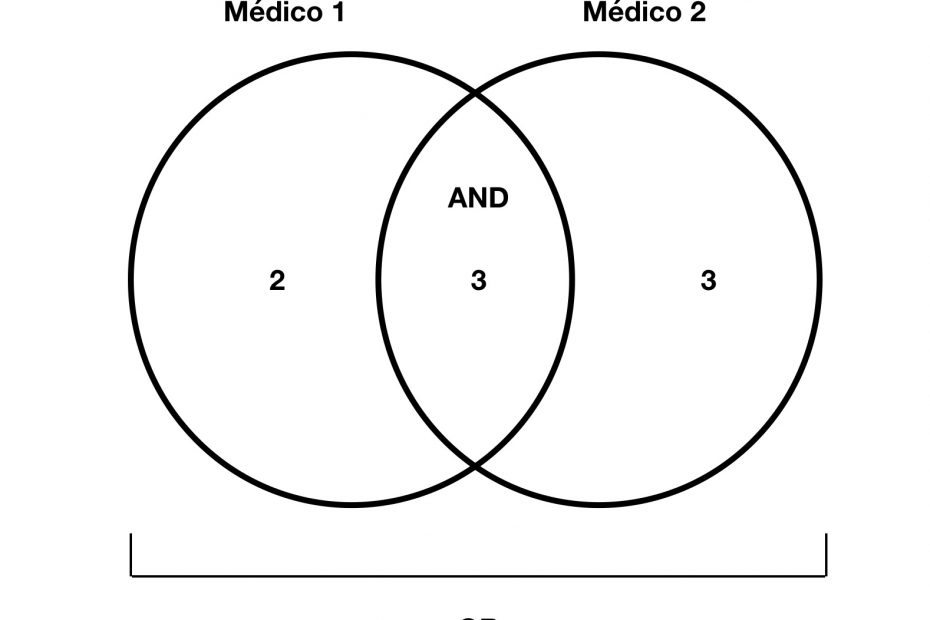
Let me give an example. We have two physicians assessing a patient with leg pain in parallel. One physician lists 5 diagnostic hypotheses and the other lists 6, with 3 overlapping hypotheses. The combined final list amounts to 8 diagnostic hypotheses. This is an OR-type combination, meaning that one OR the other physician proposed the hypothesis. Since sensitivity is the ability of a test to correctly identify individuals who have the disease, by broadening the list of diagnostic hypotheses with the OR operator, the chance that the correct diagnosis is on that list is greater, right? Therefore, sensitivity increases. Now, using the logical operator AND, both physicians would have to have shared the same hypotheses; the resulting list would consist only of the overlapping diagnoses, that is, three diagnoses. This is a smaller list than either physician’s alone. In this case, with a smaller list of diagnostic hypotheses, the probability of the correct diagnosis being on the list decreases. As for specificity, which is the ability of a test to identify individuals who do not have the disease—that is, the probability that an individual who is assessed and is normal has a normal (negative) test—think of it this way: specificity is how well the examiners can distinguish those with disease from those without disease, the true negatives. With a larger list of diagnostic hypotheses (OR operator), there are more diseases to rule out, and the probability of a false-positive diagnosis is greater with more variables; with a greater probability of a false positive, the possibility of a true negative decreases, meaning that specificity decreases. With a smaller list of diagnostic hypotheses, using the AND operator, this risk of a false positive is lower, increasing the probability of the true negative and thus increasing specificity.
When we work hierarchically, colleagues’ opinions must be taken into account, and, with centralized decision-making, it is possible to increase sensitivity and specificity by using critical judgment and logical reasoning. When we work as equals, we must be careful not to reduce our sensitivity and specificity by using the wrong logical operators, and, in that case, begin treating what is not necessary. We do this unconsciously, though often incorrectly, chiefly because when we are in equivalent positions, there is no one weighing the hypotheses. But the greater problem is that the one left holding this question is often the patient, when they see one physician and then seek a second opinion. And, faced with divergent opinions, they seek a third opinion, worsening sensitivity and specificity and thus reducing the chances of getting it right. Obviously, it is very difficult to explain this problem to a patient who does not work with statistics. I observe that after a few attempts with various physicians, the patient “gives up” and chooses the opinion that pleases them most, without any criterion and without any better final sensitivity and specificity.
This is why the figure of the family physician is so important, helping the layperson to choose the best opinion in the face of divergent information.
For those who wish to delve into the mathematics behind this reasoning: when evaluating examiners in parallel with the AND operator, the final sensitivity is the product of the two sensitivities ([A]sens x [B]sens) and the specificity is [A]spec + [B]spec − ([A]spec x [B]spec). When evaluating with the OR operator, the sensitivity is [A]sens + [B]sens − ([A]sens x [B]sens) and the specificity is [A]spec x [B]spec.