Joffre M. de Rezende
Professor Emeritus of the School of Medicine of the Federal University of Goiás.
Member of the Brazilian Society and of the International Society of the History of Medicine
Updated on 12/27/2003.
e-mail: jmrezende@cultura.com.br
http://usuarios.cultura.com.br/jmrezende
The value of a symbol lies not in its design, but in what it represents.
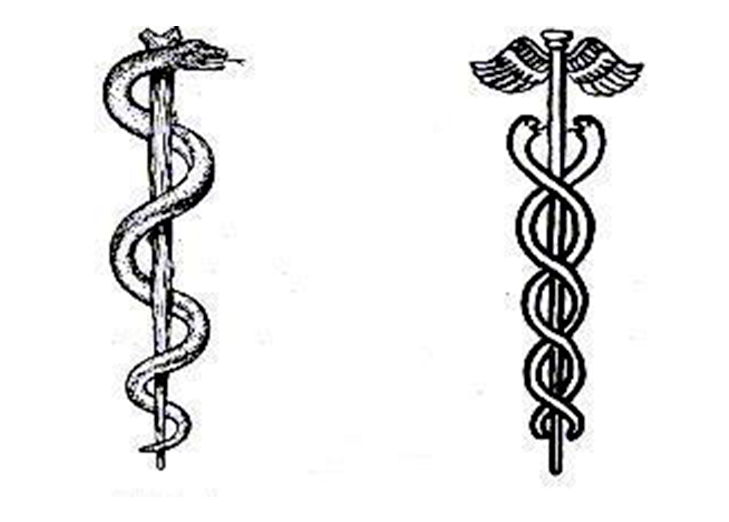
Two symbols have lately been used in connection with medicine: the symbol of Asclepius, represented by a rough staff with a serpent coiled around it, and the symbol of Hermes, called the caduceus, which consists of a more finely worked staff with two serpents arranged in ascending, symmetrical, and opposing spirals, and with two wings at its upper end.
Both symbols have their origin in Greek mythology; that of Asclepius, god of medicine, is the symbol of the medical tradition; that of Hermes, god of commerce, of travelers, and of roads, was introduced belatedly into medical symbolism (fig. 1).
 width=261>
 |
|
Figure 1 |
|
| Symbol of Asclepius |
Symbol of Hermes |
In Greek mythology, Asclepius is the son of Apollo and the nymph Coronis. He was raised by the centaur Chiron, who taught him the use of medicinal plants. He became a famous physician and, according to legend, in addition to curing the sick who sought him out, he began to resurrect those he found already dead, overstepping the limits of medicine. For this he was struck down by a thunderbolt from Zeus. After his death, he was worshipped as the god of medicine, both in Greece and in the Roman Empire.[1,2]
In various Greek and Roman sculptures and in descriptions from classical texts, Asclepius is always represented holding a staff with a serpent coiled around it. [3-7]
It is not our aim at present to discuss the meaning of the staff and the serpent, but rather to analyze the reasons why the symbol of Hermes has come to be used as a second symbol of medicine.
Hermes, in Greek mythology, is regarded as a dishonest and deceitful god, cunning and mendacious, the deity of profit and the protector of thieves. [8-12] His first act, just after his birth, was to steal part of the cattle of his brother Apollo, denying the theft. It took the intervention of Zeus, who compelled him to confess the theft. To reconcile himself with Apollo, Hermes gave him the lyre, which he had invented by stretching, over the shell of a tortoise, strings made from ox gut. He then invented the flute, which he also gave to Apollo. Apollo, in return, gave him the caduceus.
Caduceus, in Latin, is the translation of the Greek kherykeion, the staff of the heralds, which served as a safe-conduct, conferring immunity on its bearer when on a peace mission. The primitive caduceus had no wings at its upper end; these were added later.[13,15]
Hermes had the ability to move at the speed of thought and thus became the messenger of the gods of Olympus and the god of travelers and roads. Since commerce in antiquity was of the itinerant kind and was carried on especially by travelers, Hermes was consecrated as the god of commerce. Another task assigned to him was that of conveying the dead to their underground abode (Hades).[8-11]
With the Roman conquest of Greece, the Romans assimilated the gods of Greek mythology, changing their names: Asclepius came to be called Aesculapius, and Hermes, Mercury.
According to philologists, the name Mercury given to Hermes by the Romans derives from merx, merchandise, trade.[16] The metal the Greeks called hydrárgyros came to be called mercury because of its mobility, which makes it slippery and hard to grasp.[12] The planet Mercury, in turn, owes its name to the fact that it is the fastest in the planetary system.
The caduceus has long been the symbol of commerce and of travelers, and is for that reason used in the emblems of commercial associations, business schools, accounting offices, and railway stations.
The main question of the subject we are addressing then arises. Why did the symbol of the god of commerce come to be used also as a symbol of medicine?
More than one historical fact contributed to this happening.
1. In the exchange between Greek and Egyptian civilization, the god Thoth of Egyptian mythology was assimilated to Hermes, and from this syncretism resulted the designation of Egyptian Hermes, or Hermes Trismegistus (thrice great), given to the god Thoth, considered the god of knowledge, of the word, and of magic.[17] In the Egyptian pantheon, the god of medicine corresponding to Asclepius is Imhotep and not Thoth.[2]
2. Between the third century BC and the third century AD, an esoteric literature called Hermetic developed, in allusion to Hermes Trismegistus. This literature deals with the occult sciences, astrology, and alchemy, and has no relation to the traditional Hermes of Greek mythology. The syncretism of the Hermes of Greek mythology with Hermes Trismegistus resulted in the use of the caduceus as the symbol of the latter, and it was adopted as the symbol of alchemy. According to Schouten, from alchemy the caduceus is said to have passed to pharmacy and from there to medicine.[18]
3. A third fact to which the confusion between the staff of Asclepius and the caduceus of Hermes is attributed is due to the initiative of a highly prestigious Swiss publisher, Johan Froebe, in the sixteenth century, who adopted for his publishing house a logotype resembling the caduceus of Hermes and used it on the frontispiece of classic works of medicine, such as those of Hippocrates and Aetius of Amida. Other publishers in England and, later, in the United States used similar emblems, contributing to the spread of the caduceus.[13]
It is supposed that the publishers’ intention was to use a symbol identified with the transmission of messages, since Hermes was the messenger of Olympus. With the invention of printing by Gutenberg, information came to be transmitted through the printed word, and they, the publishers, would be the messengers of the authors. Another hypothesis is that the caduceus was mistakenly used as the symbol of Hermes Trismegistus, the Egyptian Hermes or Thoth, god of the word and of knowledge, to whom the invention of writing was also attributed. On old presses used for typographic printing, the caduceus of Hermes is found as a decorative figure.
4. Another fact that certainly helped to establish the confusion between the two symbols is that of giving the same name of caduceus to the staff of Asclepius, creating a binary nomenclature of commercial caduceus and medical caduceus.
This error dates from the nineteenth century and persists to this day.
In 1901, the French army founded a journal of surgery and medicine called Le caducée, on which are printed two stylized figures of the symbol of Asclepius, with a single serpent.[13]
Since then, the word caduceus has been used to name both the symbol of Hermes and the staff of Asclepius.
5. The fact that most contributed to the spread of the caduceus of Hermes as a symbol of medicine was its adoption by the U.S. Army as the insignia of its medical department.
The justifications and arguments for this adoption are flawed, inconsistent, and reveal, at the very least, an ignorance of mythological iconography on the part of those who held the power to bring about the change. The information that follows about this episode was gathered largely from the book by Walter Friedlander, The golden wand of medicine.[13]
The caduceus had been used, between 1851 and 1887, as an emblem on the working uniform of support personnel in the military hospitals of the United States to indicate noncombatant status. In 1887 this emblem was replaced by a red cross identical to that of the International Red Cross, founded in Switzerland in 1864.
Medical officers wore the letters M.S. (Medical Staff) on their epaulettes. In 1872, the letters M.S. were replaced by M.D. (Medical Department).
The Medical Department, however, had had its own coat of arms with the staff of Asclepius since 1818.[15]
In March 1902, medical officers began to use an emblem inspired by the cross of the Knights of St. John, or Maltese cross, whose symbolism in heraldry is that of protection, altruism, and honorability.
On March 20, 1902, Captain Frederick P. Reynolds, Commander of the Instruction Company of the General Hospital in Washington, proposed replacing the Maltese cross with the caduceus.
General G. Sternberg, head of the Medical Department, issued the following ruling: "The present insignia was adopted after careful study and is now recognized as proper to this corps. The proposed change, therefore, is not approved."
On June 14 of the same year, Captain Reynolds addressed a new letter to the Head of the Department, restating his proposal with new arguments. In a certain passage of his letter he says the following: "I particularly wish to call attention to the advisability of changing the insignia from the cross to the caduceus and of adopting brown as the color of the corps, in place of the green now in use. The caduceus was for years the insignia of our corps and is inalienably associated with medical things. It is being used by several foreign powers, especially England. As a figure, it must be acknowledged that the caduceus is far more graceful and meaningful than the present emblem" (the Maltese cross). "Green has no place in medicine."
In the meantime, there was a change in the leadership of the Medical Department, and this second letter was received by General William Henry Forwood, who not only approved the proposal but also arranged for the new insignia to be made. The design produced has seven curves of the serpents, which also reveals ignorance of the traditional caduceus, which contains at most five spirals (fig. 2).
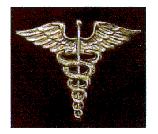 |
Fig. 2. Insignia of the Army Medical Department – U.S.A. |
The arguments used by Capt. Reynolds reveal his confusion between the two symbols. The caduceus had never been the insignia of the corps, but of the hospital support personnel (steward). It is the staff of Asclepius, and not the caduceus, that is historically associated with medicine. In England, as in France and Germany, the medical services of the armed forces used the staff of Asclepius in their emblems and not the caduceus of Hermes.
Finally, the color green has been used in connection with medicine; so much so that in Brazil the physician’s ring has, set into it, a green stone – emerald or imitation.
The subjective argument that the figure of the caduceus is more aesthetic than the Maltese cross or the staff of Asclepius is irrelevant, inasmuch as it has nothing to do with the meaning of such symbols.
In this way, the caduceus was established and remains to this day as the insignia of the Medical Corps of the U.S. Army, which greatly contributed, especially after the First World War (1914-1918), to its spread, within and outside the United States, as a symbol of medicine.(13)
The U.S. Navy likewise adopted the caduceus as the emblem of its medical corps, unlike the Air Force, which keeps the staff of Asclepius in its emblem.
The U.S. Public Health Services, in turn, adopted an old emblem of the Navy Medical Service, in which the caduceus crosses an anchor and whose former symbolism was that of maritime commerce.[22]
The first unfavorable comment on the decision of the U.S. Medical Department appeared in the form of an editorial in late July 1902 in the publication Medical News. Since then, from time to time, articles have appeared in the medical press, now justifying, now condemning the use of the caduceus as a symbol of medicine.
In 1917, Lieutenant Colonel McCulloch, librarian of the Medical Department, made the following comment:
” I think that in this country we pay too little attenction to the historical and humanistic side of things. The caduceus or wand of Mercury now used on the collar of the uniforme blouse of medical corps has really no medical bearing wathever”. (I think that, in this country, we pay too little attention to the historical and humanistic side of things. The caduceus of Mercury now in use on the collar of the Medical Corps uniform blouse has no medical significance whatever.) [19]
Fielding Garrison, a notable historian of medicine in the United States and also Lieutenant Colonel of the Medical Corps in the period from 1917 to 1935, sought to defend a posteriori the adoption of the caduceus by the Medical Department he served. Initially, he claimed that it was an administrative symbol to characterize noncombatant military personnel, acknowledging that the authentic symbol of medicine was the staff of Asclepius. Later, he sought to justify the use of the caduceus as a medical symbol on the basis of the archaeological findings of Mesopotamian civilization.
In the excavations carried out at Lagash, a vase had been found, carved from green soapstone, dedicated by the governor Gudea to the god Ningishzida, connected with medicine. On this vase there are two serpents arranged in a manner similar to that of the caduceus of Hermes. Garrison refers to the figure as the Babylonian caduceus, which is said to have preceded the caduceus of Greek civilization.[20]
The truth is that our whole culture is based on Greek civilization. All the conceptual, technical, and ethical aspects of the medical profession had their cradle in Greece with the Hippocratic school. It was in Greece that medicine ceased to be magical-sacerdotal and came to rest on clinical observation and logical reasoning. The mythical symbol of Asclepius, the staff with a single serpent, represents Greek medicine in its origins, and no other symbol, much less the caduceus of Hermes, should replace it.
In 1932, S. L. Tyson wrote an article in the journal Scientific Monthly, in which he said: “The erroneous symbol of medical profession in reality is the emblem of the god of thieves” (the erroneous symbol of the medical profession is, in reality, that of the god of thieves). [21] In reply, Garrison again asserted that the caduceus had been adopted in the army’s Medical Department as the symbol of noncombatants and regarded the matter as "a futile controversy."[13]
In recent informational material distributed over the Internet by the Army Medical Department, the following explanation is found for the adoption of the caduceus of Hermes as a symbol of medicine: “Rooted in mythology, the caduceus has historically been the emblem of physicians symbolizing knowledge, wisdom, promptness, and skill.” (Rooted in mythology, the caduceus has historically been the emblem of physicians, symbolizing knowledge, wisdom, promptness, and skill.) [22]
The confusion between the Hermes of traditional Greek mythology and Hermes Trismegistus, the god Thoth of Egyptian mythology, seems evident.
The American Medical Association kept the symbol of Asclepius in its emblem, as did most of the regional American medical societies of a scientific or professional character. Of 25 state medical associations that use the serpent in their respective emblems, 23 use the staff of Asclepius. They are those of the states of Alabama, California, Florida, Georgia, Idaho, Illinois, Kansas, Kentucky, Massachusetts, Michigan, Mississippi, Missouri, Nebraska, New Hampshire, New Mexico, New York, North Dakota, Oklahoma, Oregon, Pennsylvania, Utah, Wisconsin, and Wyoming. The caduceus is used by the associations of the states of Maine and West Virginia.[22]
The World Health Organization, founded in 1948, as could not be otherwise, adopted the symbol of Asclepius. The World Medical Association, meeting in Havana in 1956, adopted a standardized model of the symbol of Asclepius for use by civilian physicians (fig. 3).
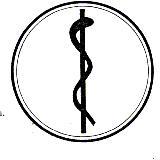 |
Fig. 3. Emblem adopted by the World Medical Association for use by civilian physicians; the serpent has two curves on the left and one on the right |
The professional, nationwide medical organizations of various countries that have an emblem with a serpent adopt, in their great majority, the symbol of Asclepius, beginning with the American Medical Association, already cited. Among the associations that do so, we may mention those of Brazil, Canada, Costa Rica, England, France, Germany, Sweden, Denmark, Italy, Portugal, South Africa, Australia, New Zealand, the countries of Southeast Asia, China, and Taiwan.[22]
Societies for the history of medicine, scientific societies of medical specialties, medical schools, medical journals, and even health insurance companies such as the Blue Cross-Blue Shield alliance use the symbol of Asclepius.
It is obvious that any symbol may be stylized, but it cannot be replaced by another. As original stylizations of the symbol of Asclepius, we may cite the following examples:
- that of the São Paulo Medical Association and that of the Brazilian Academy of Military Medicine, in which the staff takes the form of a sword;
- that of the Escola Paulista de Medicina, in which the staff is the very trunk of a tree;
- that of the Spanish Society of Occupational Medicine, in which the staff takes the form of a wrench as an instrument of work;
- that of the Brazilian Association of Medical Education, in which the staff is a torch, symbolizing the light of knowledge;
- that of the School of Medicine of Ribeirão Preto, in which the serpent takes the shape of a surgical knot.
A few national medical organizations use the caduceus of Hermes in their emblems, either in its original form or modified, such as those of Korea, Hong Kong, and the Island of Malta.[22]
The caduceus of Hermes, stylized, was also adopted by the Medical Service of the Royal Air Force, of England, differing from the Army Medical Service, which has kept its classic emblem with the symbol of Asclepius since 1898, having celebrated its centenary in 1998.[22]
Variants of the caduceus have likewise been used, resulting from two alterations introduced into the original model: the first consists in eliminating one of the serpents while keeping the wings, as in the emblems of the American Gastroenterological Association and the Facoltà di Medicina e Chirurgia of Florence; the second, keeping the two serpents and eliminating the wings, as in the emblems of the Società Italiana di Medicina Interna and the health insurance company Golden Cross.
In the United States, where the caduceus of Hermes is most widespread as a purported symbol of medicine, it is used by a few universities and medical societies, its use being more common in hospitals and public and private institutions connected with health.
According to a survey conducted up to 1980, the caduceus is used mainly by the companies that sell medical services or manage health plans in that country, reaching 76% of those that use the serpent in their emblems.[13]
In the words of Geelhoed, the caduceus has become a symbol befitting present-day medicine, if we consider that the economic aspects of health have become more important than its human aspects.[21] With the intermediation of medical services by for-profit companies, medicine has become an object of commerce for third parties. The physician has become merely a service provider and the patient a consumer, both subject to previously established contractual norms. In this sense, the use, by these companies, of the caduceus of Hermes, symbol of commerce, would be justified.
For those who wish to preserve the ideals of the medical tradition, however, there is only one acceptable symbol, which is that of Asclepius.
The unfavorable criticisms of the use of the caduceus of Hermes as a symbol of medicine persist to the present, as shown by the following comments, which we transcribe below, published, respectively, in 1988, 1996, and 1999.
“The caduceus is a usurper – a latecomer to medical symbolism and a pretender of suspect lgitimacy”(the caduceus is a usurper, a latecomer to medical symbolism and a pretender of suspect legitimacy).[23]
‘”The association of physicians with thievery through the adoption of Hermes caduceus as a medical symbol is undoubtedly undesirable and only those cynics who accuse physicians of an excessive interest in making money may find it apropriated” (The association of physicians with thievery through the adoption of the caduceus of Hermes as a medical symbol is undoubtedly undesirable, and only those cynics who accuse physicians of an excessive interest in making money may find it appropriate.) [24]
“The caduceus has nothing to do with health, healing or medicl arts”. “The United States Army resolute in error as armies tend to be, adopted the Caduceus as the insignia of the medical arm. The power of the military’s influence displaced the Aesculapian staff from the mythic place”. (The caduceus has nothing to do with health, the treatment of diseases, or the medical arts. The U.S. Army, resolute in error as armies tend to be, adopted the caduceus as the insignia of its Medical Department. The power of the military’s influence displaced the staff of Asclepius from its mythic place.) [25](Collins, S.G., 03/18/1999). [20]
As Tyson suggested, the symbol of Hermes could be used, at most, on hearses, since one of Hermes’s duties was to conduct the dead to their underground abode.[21] Apart from that, the caduceus of Hermes, as a medical symbol, is a heresy.
In Brazil, the symbol of Asclepius prevails in medical circles. The Brazilian Medical Association, as well as the affiliated state societies that have an emblem with the serpent, use the correct symbol of the god of medicine.
We are witnessing, however, the spread of the caduceus of Hermes among us, through the media: television, newspapers, printed matter, advertisements, stickers, and designs on objects and utensils intended for physicians and medical students. As Prof. Alcino Lázaro da Silva noted, "the Brazilian media, by mistake, by fallacy, by misinterpretation, by misinformation, or by bad faith, has come to use the symbol of commerce as an illustration when referring to medical news."[26]
Software intended for hospitals and medical offices, imported from the United States or inspired by it, has also contributed greatly to the propagation of the caduceus, by using it as an identifier of its purpose.
Regrettably, the caduceus as a symbol of medicine can already be found in our country in journals and medical societies of more recent foundation, on Internet sites devoted to medicine, and even in the printed matter of some universities.
We believe a campaign of clarification is needed, especially in the Schools of Medicine, among undergraduate students, to alert them to the one and true symbol of medicine: the staff of Asclepius with a single serpent. The caduceus of Hermes, symbol of commerce, should be seen as a symbol unsuited to the noble ideals of medicine.
Bibliographic references
1. CASTIGLIONI, A. Histoire de la médecine (trad.) Paris, Payot, 1931.
2. MAJOR RA. A History of medicine. Springfield, Charles C. Thomas, 1954.
3. KERÉNYI C. Asklepios. Archetypal image of the physician’s existence. London, Thames and Hudson, 1960
4. EDELSTEIN EJ, EDELSTEIN L. Asclepius. Collection and interpretation of testimonies. Baltimore, The Johns Hopkins Univ. Press, 1993.
5. FONS JW Jr. The serpent as a medical emblem. Marquette Med. Rev. 26:13-15, 1960.
6. LAWRENCE C. The healing serpent. The snake in medical iconography. Ulster Med. J. 47:134-140, 1978.
7. WILLIAMS NW. Serpents, staffs, and the emblems of medicine. JAMA 281:475-6, 1999.
8. BRANDÃO JS. Mitologia grega, vol. 2, 2.ed. Petrópolis, Ed. Vozes, 1988.
9. CHEVALIER J, GHEERBRANT, A. Dicionário de símbolos, 2.ed. (trad.). Rio de Janeiro, José Olympio Ed., 1989.
10. ENCYCLOPAEDIA BRITTANNICA. Chicago, 1961
11. HAMILTON E. A mitologia, 3.ed. (trad.). Publ. D. Quixote, Lisboa, 1983.
13. FRIEDLANDER WJ. The golden wand of medicine. Westport, Greenwood Press, 1992
15. MUñOZ P. Origins of caduceus. Maryland State Med. J. Oct. 1981, p.35-40.
16. ERNOUT, A. & MEILLET, A.: Dictionnaire étymologique de la langue latine. Histoire des mots, 4.ed. Paris, Ed. Klincksieck, 1979.
17. FOWDEN, G. The Egyptian Hermes. New Jersey, Princeton University Press, 1993.
18. SCHOUTEN J. The rod and serpent of Asklepios. Symbol of medicine. Amsterdam, Elsevier Publ. Co., 1967.
19. McCULLOCH, CC. Jr. – The coat of arms of the medical corps. Militarçy Surg. 41:137-148, 1917.
20. GARRISON FH. The babylonian caduceus. Mil. Surg. 44:633-636, 1919.
21. TYSON, SL. The caduceus. Sc. Monthly 34:492-498, 1932.
22. INTERNET. Diversos sites de busca em Asclepius, caduceus, symbol, medical associations e outros.
23. GEELHOED GW. The caduceus as a medical emblem. Heritage or heresy? Southern Med. J. 81:1155-1161, 1988.
24. NICHOLS, D. – Iatros, vol. 10, n. 10, 1996
25. COLLINS, SG.- Comments on the book The golden wand of medicine, march 18, 1999 (22)
26. LÁZARO DA SILVA, A. – Símbolo da medicina. Bol. Inf. C..C.. 43-45, abril/junho 1999.
Note: Of all the bibliographic sources cited, special mention is due to the book by Walter J. Friedlander – The golden wand of medicine – whose reading we recommend to all interested in the subject.
*Opening lecture of the IV Brazilian Congress of the History of Medicine, held in São Paulo, 12/17-18/1999